 Coin Price India
A PI-to-INR calculator needs the correct PI quantity, a matching market rate and a clearly defined currency conversion. For a sale, it also needs costs and actual settlement access. A total app balance multiplied by a search-result price is not a reliable cash-out estimate.
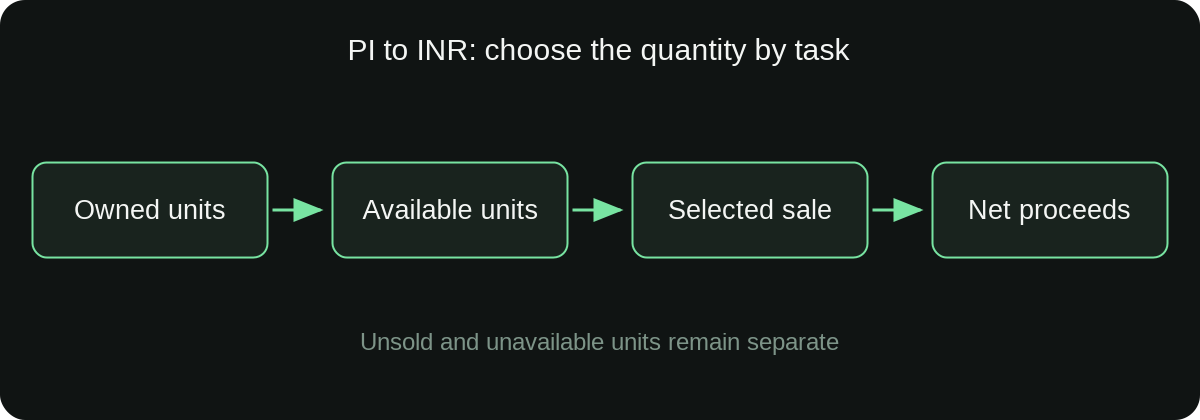
Choose the calculation you actually need
There are at least three useful outputs: a dated reference for a holding, an estimate of selling a selected quantity and a reverse calculation for a target rupee amount. Keep them separate because they require different inputs.
The one-PI conversion article explains the unit-rate arithmetic. This guide extends that into a holding-level worksheet with balance states, partial sales, deductions and reconciliation.
Pi's Open Network launch announcement belongs to its February 2025 chronology. It should not be read as a statement that every app balance is currently transferable or that every user has the same access conditions.
Start with the balance category and intended task before fetching a rate. That prevents a useful calculator from answering the wrong economic question.
Divide the holding into relevant balance states
Distinguish recorded app units, migrated units, locked units and units actually available for the intended route. Use your own authenticated account and wallet records rather than copying another person's status.
A purely hypothetical holding might show 250 migrated units, of which 100 are unavailable under a lock condition. That leaves 150 before other applicable conditions or costs. These invented quantities do not assert a particular Pi rule or a real user's balance.
If the task is valuing ownership, explain how unavailable units are treated. If the task is an immediate sale, use only the quantity eligible for that route. Do not delete locked units from the historical record simply because they cannot fund today's transaction.
Keep a separate row for every unresolved balance. A calculator should be able to say not yet verified rather than converting uncertainty into zero or assuming full availability.
Keep the currency direction explicit
For a market quoted in USDT per PI, the reference formula is:
PI quantity × USDT per PI × INR per USDT = indicative INR value.
A rate expressed as PI per USDT must first be inverted. A rate expressed as USDT per INR also has the opposite direction from the formula. Write the units beside every number so they cancel correctly.
Do not assume that a dollar reference and an Indian stablecoin funding or settlement rate are identical. Choose the rate that matches the stated purpose and preserve its source and observation time.
For a reference calculation, label both timestamps. For execution planning, refresh the relevant market and route inputs before acting. The moment you open the spreadsheet is not the timestamp of every input it contains.
Model a partial sale with visible deductions
Assume a fictional sale of 50 PI at an average execution price of 0.25 USDT per PI. Gross proceeds would be 12.50 USDT. If all applicable quote-currency costs in this simplified example total 0.50 USDT, the amount remaining would be 12 USDT.
At an invented settlement rate of 90 INR per USDT, that corresponds to 1,080 INR before any additional applicable costs or reporting consequences. These figures teach the method; they are not current prices, provider fees or a verified Pi withdrawal route.
| Worksheet line | Illustrative result |
|---|---|
| Selected sale quantity | 50 PI |
| Gross quote-currency proceeds | 12.50 USDT |
| Simplified quote-currency costs | 0.50 USDT |
| Net quote-currency amount | 12 USDT |
| Indicative rupee settlement | 1,080 INR |
The conclusion is that the selected quantity and deductions determine the sale estimate. The unsold holding remains a separate record rather than disappearing into the calculation.
Reverse the formula for a target amount carefully
If you need a target rupee amount, work backward through the actual settlement rate and costs. Add fixed quote-currency deductions before dividing by the expected average sale price.
This simplified reverse calculation assumes price and costs remain constant. A larger order may receive a different average execution, while percentage fees or minimums require another adjustment. Do not extrapolate a small quote across an unlimited quantity.
Check whether the required sale exceeds your available units. A spreadsheet can calculate a theoretical quantity even when the account cannot deliver it. Include an availability test rather than treating the result as an instruction to transact.
For multiple sale lots, preserve each trade's price and fees. A weighted total is more informative than applying the final trade's rate to the whole history.
Verify the route outside the calculator
Pi's KYB business list is a project resource, not a guarantee of account access, liquidity or returns. Check the actual provider's current terms, supported asset and network conditions.
A buyer's private valuation or community agreement is not automatically the same as a public market bid. Nor does a converter page establish a direct INR pair or bank withdrawal capability.
For Indian use, preserve acquisitions, transfers, executed trades and settlement records. Review reporting and tax treatment on those facts rather than treating the calculator output as a legal classification.
After execution, reconcile estimated and actual quantities, fees and receipts. Keep the original estimate with its assumptions. This turns the worksheet into an accountable record rather than a number that is repeatedly overwritten to match the latest screen.
Name each saved scenario so an estimate using a different quantity or rate cannot be mistaken for a revision to an executed transaction.
Frequently asked questions
Can I keep a reference value for units I do not plan to sell?
Yes, if the asset and method are identified and limitations are explicit. A reference mark should remain separate from realised proceeds and from any claim that the entire holding could exit at that rate.
How should I handle several purchases with different INR costs?
Retain each acquisition record and the relevant costs separately. A combined market-value calculation does not determine the accounting treatment of those lots or replace transaction-level evidence.
What if my final bank receipt differs from the estimate?
Reconcile the executed price, quantity, deductions and conversion rate stage by stage. Record the unexplained remainder instead of automatically attributing every difference to the PI market.