 Coin Price India
For an Indian user, the meaningful cost is the rupees spent for the correctly identified tokens that reach the intended destination. A converted headline price does not include every trading, transfer or exit cost. Resolve whether you mean XHAM, HAM or HMSTR before starting the calculation.
Fix the asset before building the Indian route
The general Hamster page on Coinbase labels HAM, while an X Hamster tracking page uses another asset reference. Those pages illustrate a naming issue; they do not jointly authenticate one universal hamster investment.
Use the full name, chain and identifier in your cost worksheet. A source saying only hamster is not precise enough. If the token is a representation on another network, identify the issuing or conversion mechanism and the destination support as well.
Do not interpret a price page written for Indian readers as proof that an INR market exists. A provider can translate a dollar observation into rupees without supporting Indian payments or holding the asset for you.
Build the route from both ends
At the beginning, identify your permitted funding method and account. At the end, identify the wallet or service that will hold the token and a possible route back to INR. The middle market is useful only if those endpoints are compatible.
This avoids a common sequence in generic tutorials: buy USDT first, then discover that the intended token cannot be acquired or withdrawn. Funding and investment are separate decisions. The first successful payment does not validate the second transaction.
If a route requires another person's verified account, a false location or an unverified private broker, stop. A better-looking unit price does not compensate for an unsuitable access arrangement.
A worked delivered-cost example
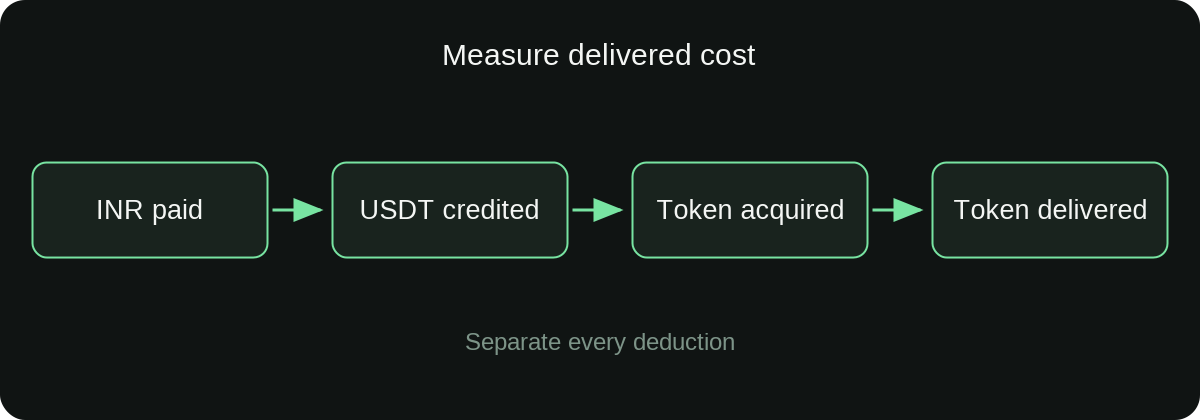
Consider hypothetical arithmetic, not a current hamster quotation. Suppose ₹9,000 acquires 100 USDT. A later transfer costs 2 USDT, leaving 98 USDT. If the token purchase price were 0.01 USDT per unit, that would acquire 9,800 units before any further charge.
If delivering the token then deducted 100 units, the destination would receive 9,700. The original ₹9,000 divided by 9,700 gives about ₹0.9278 per delivered unit. Simply multiplying 0.01 by ₹90 would have suggested ₹0.90, omitting the route costs.
Every input here is illustrative. Replace each with the actual quoted or completed amount for your own record. The purpose is to expose cost layers, not suggest that a particular token trades at 0.01 USDT or that those charges apply to a real venue.
Distinguish fees, spread and price impact
An explicit fee is only one component. The difference between buying and selling quotes creates a spread. Executing a larger quantity across available orders or a liquidity pool can create additional price impact.
| Cost layer | What to measure |
|---|---|
| INR funding | Actual rupees paid for the credited funding asset |
| First transfer | Net amount reaching the trading destination |
| Token execution | Quantity received for the amount actually spent |
| Final transfer | Tokens delivered after deductions |
| Later exit | Amount realised after reversing the appropriate route |
A zero-fee advertisement does not establish a zero-cost trade. Inspect the received amount and compare equivalent routes at compatible times. Do not add unrelated quotes from different days and call the result an executable plan.
Low unit prices require careful arithmetic
Keep sufficient decimal precision in each input and store the original values. Multiplying a rounded small token price by a large quantity can produce a substantial error. A missing leading zero can change the estimate by an order of magnitude.
Check whether the market form rounds the quantity to a supported step and whether a small balance falls below an order or withdrawal minimum. Divisibility alone does not guarantee that every fraction can be economically bought and moved.
If the app displays zero, inspect whether that is rounding, missing data or an actual observation. Those states require different interpretations. Do not conclude that the entire market is worthless or that a bargain exists from the display alone.
Estimate a sale separately from the purchase
The route back to INR can have different prices, fees and availability. A token position's display value is not the amount a buyer will pay for your quantity. Inspect actual bids or the complete swap quote rather than using the latest small trade.
After a sale into a stablecoin, you still hold that stablecoin until a separate permitted INR conversion is completed. Bank receipt and platform trade completion are different events. Keep their records linked but distinct.
A transaction route working once does not guarantee permanent liquidity. Recheck service status and destination instructions before a later sale. Do not treat an old test transfer as an assurance that every future order can be executed.
Keep the Indian records while amounts are small
Retain payment references, order fills, network transaction IDs and any platform deductions. Identify the exact asset in every entry. A spreadsheet saying only hamster can become ambiguous when reconstructing older transactions.
Do not assume that a small amount, a brief holding period or an offshore platform removes reporting obligations. Seek advice on the actual transactions where needed. An exchange deduction is not automatically proof that every tax or recordkeeping task has been completed.
Avoid paying a private person who claims to settle your taxes as a prerequisite to withdrawal. Verify the obligation, recipient and official process independently. A payment demand is not valid merely because it uses a familiar regulatory word.
Use a cost ceiling rather than chasing the quote
Set a maximum total expenditure and minimum acceptable delivered amount before authorising the route. If the quote changes materially, review the plan rather than repeatedly increasing tolerance to force completion.
A sensible result can be that costs or uncertainty make the proposed amount uneconomical. You do not need to purchase a token to complete a price comparison. The objective is a decision based on usable evidence, not a transaction at any price.
Use the hamster identity guide if the token name or contract is still unresolved.
Frequently asked questions
Should I include an unused USDT remainder in the token's cost?
Record it separately. Allocate actual expenditure consistently rather than pretending the residual disappeared or counting it as delivered hamster tokens.
What if two routes deliver the same token amount at different times?
Compare service conditions, transfer risks and timing as well as the rupee total. A cheaper quotation is not equivalent if it depends on an unverified or unavailable step.
Can I call a hypothetical conversion my acquisition cost?
No. Preserve the actual payment and executed trade records. Illustrative arithmetic helps planning, but it does not replace evidence of what you paid for a real holding.