 Coin Price India
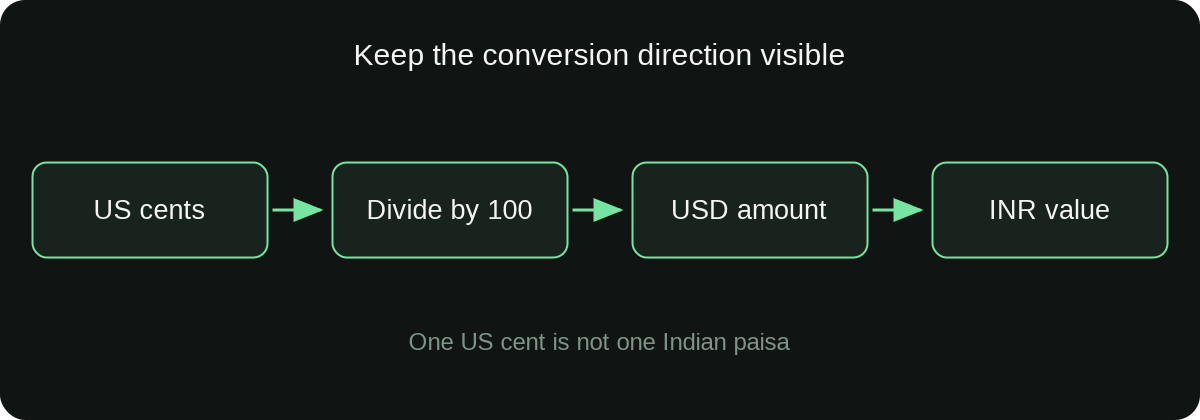
One US cent is 0.01 US dollar, so its indicative rupee value is the USD/INR rate divided by 100. It is not one rupee or one paisa. First confirm which currency's cent you mean, because several currencies use that word.
Identify the currency before doing the arithmetic
A dollar symbol can refer to more than one national currency. A cent amount in a US statement is not automatically equivalent to the same cent amount in an Australian or Singapore statement. Keep the currency code with the number.
The US Mint's educational dollar reference identifies the US dollar as a 100-cent unit. That establishes the decimal relationship for USD. It does not supply a current foreign-exchange quote or guarantee that a bank will exchange a single physical cent.
If a website says you earned cents without identifying the currency or payout terms, resolve that uncertainty first. Otherwise a technically correct conversion can still value the wrong unit or a balance that cannot be withdrawn.
Convert US cents to INR in two steps
First divide the cent amount by 100 to obtain dollars. Then multiply by the rupees-per-dollar rate. Keeping the steps separate makes the units easier to audit and reduces decimal errors.
For illustration only, if the chosen rate were ₹90 per USD, one US cent would have an indicative value of ₹0.90, or 90 paise. Ten cents would be ₹9 and 100 cents would be ₹90. The ₹90 rate is hypothetical, not a current exchange-rate statement.
The reverse calculation uses division. To estimate cents corresponding to a rupee amount, divide rupees by the INR-per-USD rate and multiply by 100. Do not multiply by an inverse rate without checking its label; that can produce an answer with the wrong scale.
Rupees and paise are another decimal relationship
One rupee consists of 100 paise. That relationship is within INR and does not depend on foreign exchange. Converting from US cents to paise requires the cross-currency calculation first.
| Expression | What it means |
|---|---|
| 1 US cent | 0.01 USD |
| 1 paisa | 0.01 INR |
| INR per USD | Rupees corresponding to a dollar under the chosen rate |
| USD per INR | The inverse currency-rate direction |
| A website credit | A programme balance requiring its own unit and payout conditions |
The distinction matters when reading small prices or micro-earning advertisements. A phrase such as one-cent reward is not a rupee-denominated payment promise unless the issuer expressly defines and supports that interpretation.
A conversion estimate is not a payout quote
A reference exchange rate gives a calculation basis. A bank, payment service or platform may apply its own spread, charges and minimums under the actual product terms. A very small amount can be mathematically valuable while being uneconomical or impossible to transfer by itself.
For a website earning balance, inspect the withdrawal threshold, payment method, supported countries and expiry. A number displayed with two decimals can conceal a different underlying unit, such as points or estimated revenue. Ask what is actually owed and under which conditions.
Do not pay an unexplained activation fee to receive a tiny balance. Compare the demand with the programme's documented terms and the identity of the recipient. The fact that an amount can be converted does not authenticate the person asking for payment.
Physical pennies are not a foreign-exchange account
A US penny is a coin with a face value. Exchanging a physical foreign coin can involve different practical conditions from converting a dollar bank balance. A money changer may not accept all small foreign coins, and collecting value is a separate question from face value.
The US Mint's penny FAQ explains that the penny remains legal tender despite the suspension of circulating production. Do not interpret a production change as proof that every penny is now a valuable collectible or that its face-value relationship has changed.
A collectible assessment would require the actual coin, condition and relevant market. A generic cent-to-rupee calculator cannot establish that. Keep an ordinary conversion and any claimed collector premium in separate columns.
Use consistent precision in a spreadsheet
Store the original currency code, cent quantity, rate, rate direction and observation date. Calculate in sufficient precision and round only the final display or as required by the transaction. Do not discard the original inputs after rounding.
For many small payments, round-policy differences can accumulate. If a platform rounds each entry while your spreadsheet rounds only the final total, the results may differ even when both use the same rate. Reconcile the method before alleging that a balance is missing.
Keep a second column for actual receipts. That makes the gap between indicative converted value and settled rupees visible. Fees and differences in timing can then be explained rather than buried in an unexplained adjusted exchange rate.
Crypto prices expressed in cents need one more check
A token said to trade at one cent needs an identified asset and actual quote. A low unit price does not establish that the token is cheap, and it does not prove that every unit can be sold at the displayed level.
If the market pair uses USDT, retain that denomination instead of silently substituting bank dollars. Then examine the actual route to INR and its conditions. A US-cent comparison may be convenient for reading, but it cannot replace market or payment verification.
The same principle applies to token price targets. Saying a token could reach one cent is a forecast, not a currency conversion. To assess the claim, examine supply and market assumptions separately from the arithmetic converting one US cent into rupees.
Frequently asked questions
Does a site displaying $0.00 necessarily owe me nothing?
Not necessarily. Display rounding can hide a sub-cent balance. Check the underlying amount and payout rules rather than assuming the visible two-decimal number is the complete ledger.
Can I use yesterday's exchange rate to reconstruct an old receipt?
Use the method and date relevant to the record you are preparing. Keep the actual receipt and any required valuation basis separate from a convenient current calculator rate.
What if the statement says cents but has no currency code?
Ask the issuer to identify the unit and payment terms. Do not assume USD merely because the interface is in English or uses a dollar-like symbol.