 Coin Price India
The indicative INR value of one transferable PI is its verified market quotation multiplied by the relevant currency conversion rate. It is not the value of every unit displayed in a mining app, and it is not automatically the cash you can withdraw. Keep those distinctions visible from the first calculation.
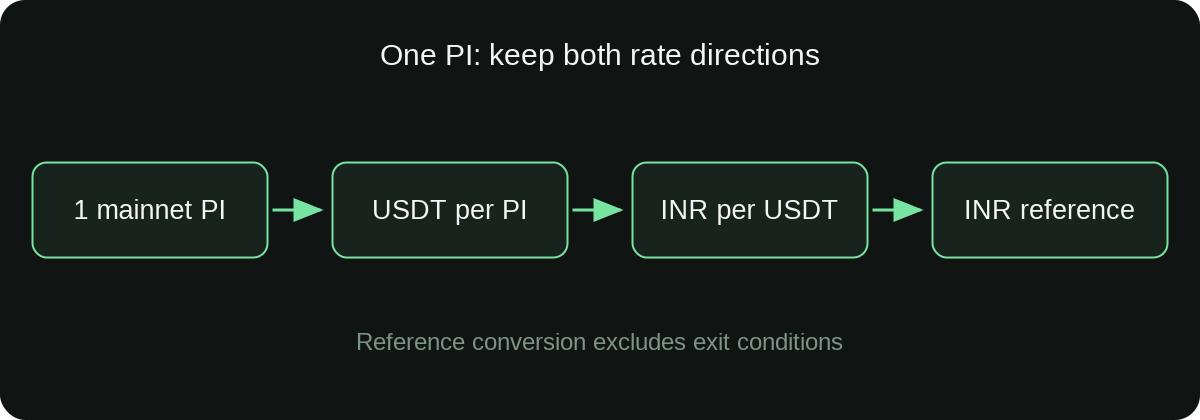
Define the one coin being valued
Your reference unit should be identified mainnet PI, not an old IOU or an unfulfilled account entitlement. For a real holding, confirm the available state in the wallet or service before attaching a market value. One unit promised for later delivery is not necessarily one unit ready for sale.
Pi's Open Network announcement places the external-connectivity transition in February 2025. That date is relevant when interpreting old price articles, but it does not authenticate every modern quotation or trading service.
The broader Pi market-identity guide explains the different balance states. Here the task is narrower: calculating a defensible value for exactly one identified unit using clearly labelled inputs.
Use the rate direction explicitly
If the market quote is PI/USDT, the indicative calculation is one PI multiplied by USDT per PI, then INR per USDT. If the quote is PI/USD, use INR per USD instead. Do not switch denominations midway because both are displayed with a dollar sign.
For arithmetic only, suppose the selected quotation were 0.25 USDT per PI and the conversion were ₹80 per USDT. One PI would then have an indicative value of ₹20 before costs. Neither input is a current market observation or an investment forecast.
The inverse question is different. To estimate PI corresponding to a rupee budget, divide the rupee amount by the comparable per-PI INR rate. Retain the original direction of each input so the spreadsheet does not accidentally multiply by an inverse rate.
Choose the right observation for your purpose
For an indicative portfolio mark, a documented reference price may be sufficient if its limits are clear. For a sale decision, the relevant bid or complete route quote for the quantity matters. For a completed transaction, use the actual execution record rather than a later chart.
| Purpose | Appropriate starting evidence |
|---|---|
| Learning the conversion | Explicitly hypothetical inputs |
| Personal indicative valuation | Identified price source, asset and timestamp |
| Preparing an order | Available execution for the amount and account |
| Recording a completed sale | Fills, fees and proceeds actually received |
| Seeking tax advice | Transaction facts and the applicable valuation method |
Do not mix the rows to produce a more attractive result. A later high is not the price of an earlier completed sale, and an example rate is not acquisition-cost evidence.
Fixed costs can dominate a one-coin sale
A single coin's reference value can be smaller than the minimum order or transfer charge. That does not necessarily mean the coin has no value; it means the proposed route may not be economical at that size.
Continuing the hypothetical ₹20 example, a separate fixed charge equivalent to ₹80 would make that isolated route uneconomic. The ₹80 is not a stated Pi fee. It demonstrates why multiplying one unit by a quote cannot establish net cash proceeds.
Check whether costs are deducted from the asset, added in another unit or subject to a minimum. Keep any unsold remainder separate from realised cash. Do not describe a fractional leftover as money already available in a bank account.
Verify the venue without extending its status
Pi maintains a list of KYB-verified businesses for its ecosystem. Use it for the question it addresses, then check the venue's actual services and your individual eligibility. Do not treat the list as insurance against market loss.
Inspect deposit and withdrawal support as well as trading. An available quote does not prove that your existing PI can be deposited or that newly purchased coins can reach your intended wallet. A rupee display also does not establish a direct Indian payment channel.
Use accurate identity and residence information. If a proposed route depends on a borrowed account or a false location, the arithmetic may be correct while the plan remains unsuitable. A usable conversion requires a legitimate route, not just compatible numbers.
Deal with rounding and apparently inconsistent figures
Store unrounded inputs and round the final display to the precision suitable for the task. If each provider rounds at a different stage, small differences can arise even when the underlying observations are close.
Compare the asset, market, quote type and observation time before attributing a discrepancy to an error. An INR chart can also change because the conversion rate changes. Retain that currency component separately from PI's quoted market movement.
When no fresh source can be verified, label the estimate unavailable or historical. Do not automatically carry yesterday's figure into a page called today. The absence of usable data is a relevant result, not a reason to manufacture precision.
Turn the calculation into a useful personal record
Save the quantity, asset state, market quotation, conversion input, timestamp and excluded costs. For a sale plan, add the expected route and minimums. For a completed sale, attach the actual trade and bank evidence instead of keeping only the preliminary estimate.
A record with those fields can be reproduced later. It also helps explain why a final receipt differs from an initial converter value. Without it, a single rupee total hides the assumptions you would need to investigate.
You can value one coin without deciding to buy or sell it. Keep the informational calculation separate from the investment decision and from any deadline suggested by a promoter. A transparent estimate is useful precisely because it does not pretend to be a guaranteed payment.
Frequently asked questions
Can one PI be valued differently in two private goods transactions?
The parties can agree different commercial terms. Preserve each agreement and do not treat its negotiated value as an unrestricted market quotation for all holders.
How should I label an estimate prepared after the market closes on a reference source?
Record the source's observation time and the estimate's preparation time separately. A calculation made later is not a new underlying trade or a fresh quote.
Does changing my spreadsheet currency to INR convert the asset?
No. It changes the display or valuation. A real conversion requires the relevant executed transaction and does not occur merely because the spreadsheet shows rupees.