 Coin Price India
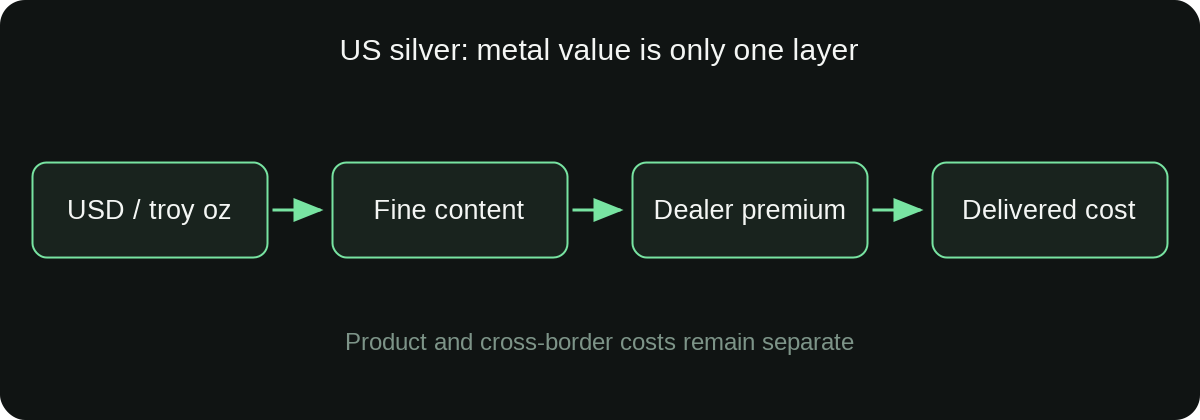
US silver prices are commonly quoted in dollars per troy ounce, while a dealer charges for a particular product and transaction. Spot value, a coin's face value and the amount an Indian buyer pays are different measures. Compare fine-silver content and complete costs before choosing an offer.
Identify the US silver number on the screen
A spot reference concerns metal pricing, a futures quote concerns a specified contract and a retail quote concerns a product available under a dealer's terms. A chart heading alone may not make that distinction clear.
The CME silver specification describes the standard SI contract as 5,000 troy ounces, quoted in US dollars and cents per troy ounce. That is a derivatives contract, not a one-ounce coin order.
The US Mint's bullion information describes specific American Eagle silver bullion products. A government-minted coin remains a particular product with its own selling channel and retail premium; its official origin does not make every online dealer authentic.
Read the unit, contract or product, observation time and whether the price is a bid or offer. Those fields determine what comparison is possible.
Use troy weight rather than an ordinary ounce
Precious-metal quotations use troy ounces. One troy ounce is approximately 31.1035 grams, as reflected in the CME silver delivery rules. An ordinary avoirdupois ounce is a different unit.
For an indicative metal reference:
INR per gram of fine silver = USD per troy ounce × INR per USD ÷ 31.1035.
Suppose, only to demonstrate the arithmetic, silver is 30 USD per troy ounce and the exchange rate is 90 INR per USD. The reference is 2,700 INR per troy ounce, or about 86.81 INR per gram of fine silver.
These hypothetical inputs are not today's US silver price or an executable currency quote. The formula converts units; it does not include fabrication, distribution, tax or delivery.
Match fine content before comparing products
A product's gross weight and its fine-silver content may differ. For an alloy item, use the documented fineness and product specification rather than assuming all its weight is silver.
A bullion product can be sold by stated fine content, while jewellery or scrap may be assessed through gross weight, assay and deductions. Read which basis the seller or buyer uses.
| Price or quantity | What it represents |
|---|---|
| Spot reference | A metal-market observation |
| Fine-silver content | The silver quantity relevant to metal value |
| Dealer selling price | The specific product offered to the customer |
| Dealer buyback bid | What that dealer offers under stated conditions |
| Coin face value | A denomination, not a substitute for retail metal pricing |
The conclusion is practical: compare equivalent fine content and transaction terms, not simply two products described as one ounce.
Explain the dealer premium
A retail premium can reflect minting, fabrication, distribution, inventory and product demand. Collectible features can add another source of value that may behave differently from silver itself.
Compute the premium against a consistent reference and time. If the dealer price is 40 USD for a product containing one troy ounce of silver and the matching hypothetical metal reference is 30 USD, the difference is 10 USD before other transaction costs.
That calculation describes a purchase premium, not a promise that a future buyer will repay it. Obtain a buyback quote for the same product and condition if resale matters to your decision.
Packaging damage, verification requirements and dealer policy can affect the buyback offer. Keep the invoice and product details rather than assuming the metal chart explains every difference.
Add the Indian landed-cost layer
An Indian reader comparing a US offer must examine lawful availability, shipping, insurance, currency conversion and applicable import or tax treatment. A US dealer's domestic price is not automatically a delivered Indian quotation.
Do not hard-code a duty rate from an old blog. Classification, product form, origin and current rules can matter. Obtain a written landed-cost estimate from the responsible parties before committing to a cross-border order.
Compare the total against a locally available equivalent on the same fine-content basis. An apparently lower foreign price can lose its advantage once delivery and conversion costs are included.
A dealer accepting payment is not itself proof that every import condition has been satisfied. Clarify responsibility for paperwork, delivery failure, insurance claims and returns before treating the order as a simple price arbitrage.
Futures and physical ownership require different decisions
A futures position exposes the holder to contract rules, margin and potentially delivery obligations. It does not mean a small retail investor automatically owns a particular bar stored for them.
Using the standard 5,000-ounce contract solely as a mechanics example, a one-dollar-per-ounce move corresponds to 5,000 USD of gross price change per contract. This says nothing about the collateral required or an Indian reader's eligibility to trade it.
A physical holding creates storage, authentication and resale questions instead. Match the product to the task before comparing expected returns. Neither route guarantees protection against inflation or currency movements.
Keep dated quotes and complete invoices. If a source cannot establish a current observation, label it historical or unavailable. This guide offers a comparison method rather than a live US silver feed.
For a resale comparison, ask whether the dealer deducts verification or handling costs from its stated bid. Compare the net amount for the same product rather than only the advertised spread against spot.
Frequently asked questions
Does tarnish mean silver has lost its metal content?
Surface appearance and fine-metal quantity are different issues. However, condition can affect a product's retail or collectible premium. Ask the buyer how it assesses the specific item before cleaning or altering it.
Can I compare a proof coin directly with a generic bullion bar?
Only after separating their product premiums and relevant resale markets. Similar silver content does not make the collector attributes, packaging or buyer demand equivalent.
Should a dealer quote include a validity period?
Yes, a written expiry or fixing rule helps explain when the price becomes binding. Without it, an enquiry price can be mistaken for a reserved transaction during a moving market.