 Coin Price India
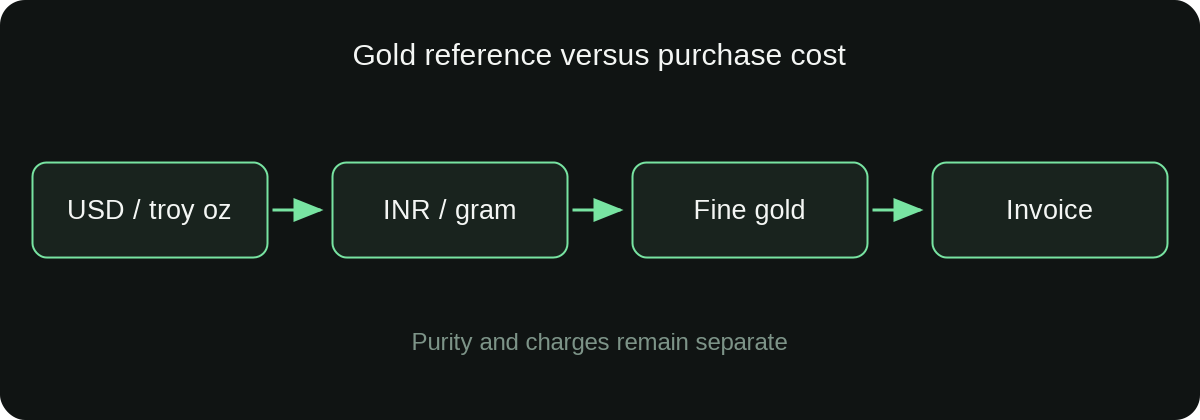
A gold chart is useful only when you know its currency, weight unit, market and timestamp. An international XAU/USD reference is not a final Indian jewellery price. Convert the metal value first, then account separately for purity, product costs and the actual seller's terms.
Identify the kind of gold price on the screen
A chart can represent an indicative spot quote, a futures contract, a benchmark auction or a retail product. Each answers a different question. A continuously updating line is not necessarily the same instrument as the daily reference used in a business agreement.
LBMA's benchmark explanation identifies the London gold benchmark in US dollars per troy ounce and describes its twice-daily auction times. That benchmark is different from every transaction occurring throughout the day. Its existence does not make a third-party widget a licensed live feed.
Look for the instrument name and data delay. If the page does not disclose them, do not compare its number with a seller's invoice as though both represent the same thing.
Use troy weight rather than an ordinary ounce
Precious-metal quotations commonly use a troy ounce. NIST's weight-conversion reference gives one troy ounce as 31.1034768 grams. Using an ordinary household ounce in the conversion produces a different result.
For a USD-per-troy-ounce quote, an indicative pure-gold INR-per-gram value is the quote multiplied by INR per USD, then divided by 31.1034768. Keep the rate direction visible. If you want a ten-gram reference, multiply the resulting per-gram figure by ten.
As arithmetic only, a hypothetical $3,000 quotation and ₹90-per-dollar conversion produce about ₹8,680.70 per gram of reference metal. These are not today's prices, and the calculation omits local charges and product differences. Retain the unrounded inputs in any working sheet.
Purity changes the amount of gold being priced
An article's total weight is not necessarily its fine-gold weight. Stones and other components should not silently be priced as gold. Likewise, a 22-carat article should not be compared directly with a pure-gold reference without accounting for its declared fineness.
Ask the seller to separate gross weight, net metal weight, fineness and non-metal components. Then apply the appropriate purity factor to the reference metal calculation. That estimate remains distinct from making charges, taxes and other actual invoice components.
Do not treat a seller's promised buyback price as identical to the purchase calculation. A later sale can involve its own testing, deductions and commercial conditions. A chart rising does not guarantee that the whole jewellery purchase cost can be recovered.
Read Indian hallmark information for its actual purpose
The Bureau of Indian Standards FAQ explains the BIS mark, declared purity and six-character alphanumeric HUID for relevant hallmarked gold jewellery. BIS also describes verification through its official consumer tools.
Hallmark information concerns the identified article and purity framework. It does not guarantee a future market return or determine that a shop's total price is the best available. Inspect the invoice and commercial terms separately.
If a product uses the word digital rather than physical, determine what legal and custody rights it actually provides. An on-screen gold balance, a token and an allocated bar are not automatically the same holding. The chart cannot resolve those differences.
Diagnose why two gold charts disagree
| Difference to inspect | How it can change the display |
|---|---|
| Spot versus futures | Different instruments and delivery references |
| Contract expiry | Different maturities can have different prices |
| Bid, ask or midpoint | Each measures a different side or calculation |
| USD versus INR | Currency conversion adds another moving input |
| Troy ounce versus gram | A unit mismatch changes the scale |
| Delay and timezone | Observations may come from different moments |
Compare equivalent observations before interpreting a discrepancy as an error. A chart stamped today can still display delayed data. A daily close can also differ between providers using different session boundaries.
Do not average incompatible series to create an apparently precise price. Decide which reference suits the task and retain its method. This makes later comparison with a purchase or sale more useful.
Chart patterns do not replace a cost calculation
A candle shows the recorded range and closing convention for a period. It does not by itself reveal the location of every stop order, investor purchase cost or future liquidation. Claims about those structures need additional data.
For a retail purchase, deciding whether the invoice is reasonable may be more useful than predicting the next hour. For a market position, specify the instrument, quantity and loss tolerance. Do not use the same chart-reading instruction for jewellery shopping and leveraged trading without explaining the difference.
An alert can help monitor a defined reference, but it should name the instrument and unit. If a provider changes the series, revisit the alert rather than assuming the threshold still measures the original task.
Prepare a comparison you can use at the counter
Record the reference date, metal quote, currency input, weight, purity, charges and total. Ask for unclear components to be explained before payment. Compare like products and terms rather than only the largest discount in an advertisement.
A useful worksheet distinguishes reference metal value from the invoice and from a possible future sale. Those three columns prevent the common mistake of treating all expenditure as gold that can later be sold at the chart price.
There is no embedded live feed in this article. For a current decision, retrieve a fresh identified quote and the actual seller's terms. The method remains useful precisely because it does not depend on a static number pretending to update itself.
Frequently asked questions
Should I include gemstone weight in the gold-price multiplication?
Do not automatically do so. Obtain the metal-weight breakdown and the separate pricing of other components; the quoted gold reference should be applied to the relevant metal quantity.
Can an old jewellery bill establish today's purity without testing?
It is useful evidence, but current identification and any required assessment still matter, particularly after alterations. Keep the article's history and invoice rather than assuming a generic chart settles the issue.
Does a rupee chart automatically include local taxes?
No. A converted display may contain only the reference metal value. Check the provider's definition and the seller's current itemised invoice for the actual purchase.