 Coin Price India
A Brent crude quote needs a contract month, a unit and an observation time. It is usually expressed in US dollars per barrel, and it is not the price of petrol at an Indian pump. Identify the instrument before comparing two screens or converting it into rupees.
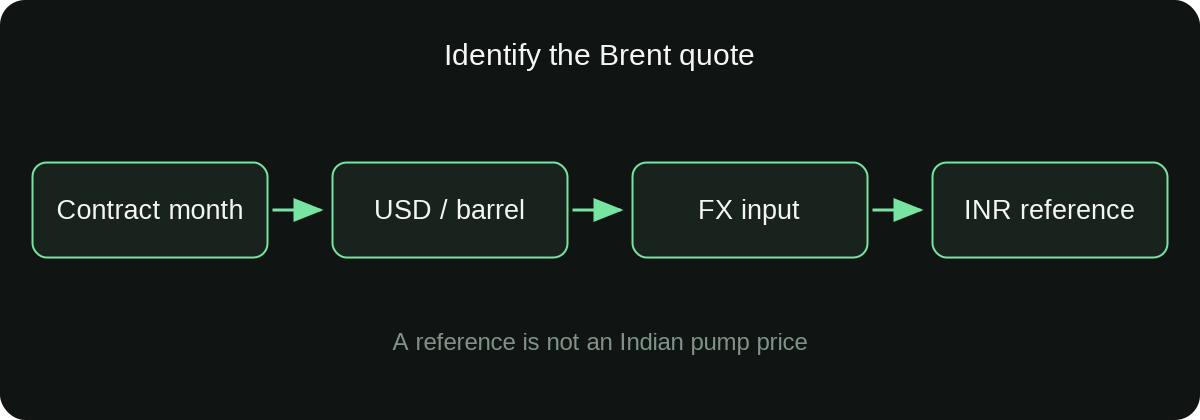
Begin with the contract rather than the headline
A news headline may refer to the nearest active futures contract, a spot assessment or a continuous chart. Those references need not have identical prices. Two accurate providers can display different values because they are measuring different instruments or observation times.
The ICE Brent contract specification identifies a standard futures contract of 1,000 barrels, quoted in US dollars and cents. That specification defines the instrument; it does not make an informational website quote executable through your Indian account.
When saving a price, record the exchange, contract month, quote type and timezone. A label containing only “Brent” is inadequate for checking a trade, a business budget or an apparent discrepancy between charts.
Understand what happens when a chart rolls
A continuous futures chart joins successive contract months to create a longer history. The provider may switch contracts according to its own schedule and may adjust past values. A jump around that switch can therefore reflect a change in the series rather than a comparable overnight move in one contract.
Before calculating a return, inspect the chart methodology. Determine whether prices are adjusted and which contract is currently represented. If the methodology is not disclosed, use the history cautiously instead of treating every plotted point as a price at which the same asset could have been bought.
ICE's explanation of the Brent ecosystem also distinguishes physical and financial components. A physical cargo assessment, forward arrangement and futures position answer different commercial questions. Do not use them interchangeably merely because all concern Brent.
Convert the reference price into INR with visible units
An indicative conversion is Brent in USD per barrel multiplied by the relevant INR per USD rate. The result remains rupees per barrel. It has not become a retail fuel rate or a delivered crude purchase invoice.
For illustration only, assume a reference of $80 per barrel and a conversion rate of ₹90 per dollar. The arithmetic gives ₹7,200 per barrel. These are hypothetical inputs, not a current Brent or currency quote. Record both inputs at compatible times if using actual observations.
A business estimating costs should add its own applicable transport, quality, financing and contractual adjustments separately. Hiding those items inside a single converted price makes it difficult to understand why a supplier's invoice differs from a chart.
Why Indian petrol prices are a different calculation
Retail fuel is a processed product with its own supply chain and pricing components. A crude benchmark is one input to a much wider calculation. Taxes, dealer arrangements, refining and distribution conditions, currency changes and timing can all matter.
Consequently, a percentage fall in Brent does not establish the percentage or date of a petrol-price change. Nor does a local price remaining unchanged prove that the international quote is false. First determine which stage of the supply chain each number represents.
For household budgeting, track the actual local fuel price separately from the crude reference. For a commercial analysis, specify the lag and cost model you use. Without that model, a claim that petrol “must fall tomorrow” is an unsupported forecast.
Read the curve before interpreting market expectations
Different contract months can trade at different prices. A later contract above an earlier one is commonly described as contango; the reverse relationship is backwardation. These relationships can reflect storage, availability, financing and market conditions, not simply a unanimous prediction of the future spot price.
Compare the same observation time across maturities. A delayed quote for one month and a live quote for another can produce a misleading spread. Keep the exact two contracts in the record rather than labelling the difference only as “oil outlook”.
Do not infer stop-loss concentrations, hidden orders or liquidation levels from a candlestick chart alone. Those claims require their own datasets. A chart can show recorded prices and trading ranges without revealing every participant's position.
A price-reading worksheet for Indian users
| Field | Why it belongs in the record |
|---|---|
| Contract and month | Establishes what the price measures |
| Bid, ask, last or settlement | Separates an order quote from a reference calculation |
| Time and delay | Makes comparisons reproducible |
| USD/INR input | Shows the currency component explicitly |
| Quantity and contract size | Connects a unit move to actual exposure |
| Additional costs | Prevents a reference price becoming a false invoice |
The quantity field is especially important for derivatives. With a 1,000-barrel contract, a $1-per-barrel movement corresponds arithmetically to $1,000 of gross price exposure per contract, before costs and currency effects. Margin posted is not the same as total economic exposure.
This example explains scale, not suitability. Check the specific product, intermediary and permissions applicable to an Indian resident before considering access. A foreign chart or app being visible does not establish that every trading or funding arrangement is permitted.
Use alerts to support a defined task
An alert should identify the instrument and level, not just the word Brent. If a provider changes the front contract, revisit the threshold. A notification attached to a continuous series can behave differently from one attached to a fixed expiry.
For a supplier discussion, save the agreed pricing reference and averaging period. For learning, keep a small observation log and explain changes using evidence. Avoid turning every headline into a trade instruction. A useful price record supports a decision without pretending to predict the next move.
Frequently asked questions
Can I compare a settlement quote with an intraday high?
They answer different questions. Label the measures and their times; a settlement calculation is not necessarily the highest transaction price observed during the session.
Does a barrel quote tell me how much a single futures contract costs to hold?
Not by itself. Contract size, margin, financing, fees and potential losses all need separate attention. The per-barrel price is only one input.
Should I round the currency rate before calculating a large purchase estimate?
Keep sufficient precision until the final result and retain the original rate. Early rounding can create a material difference when the reference quantity is large.