 Coin Price India
Ruby Coin is an ambiguous name, not a complete investment description. Before selecting a wallet or evaluating a project, establish which Ruby asset you mean and what its units actually entitle you to do. Branding does not establish ownership of gemstones, reserves or company profits.
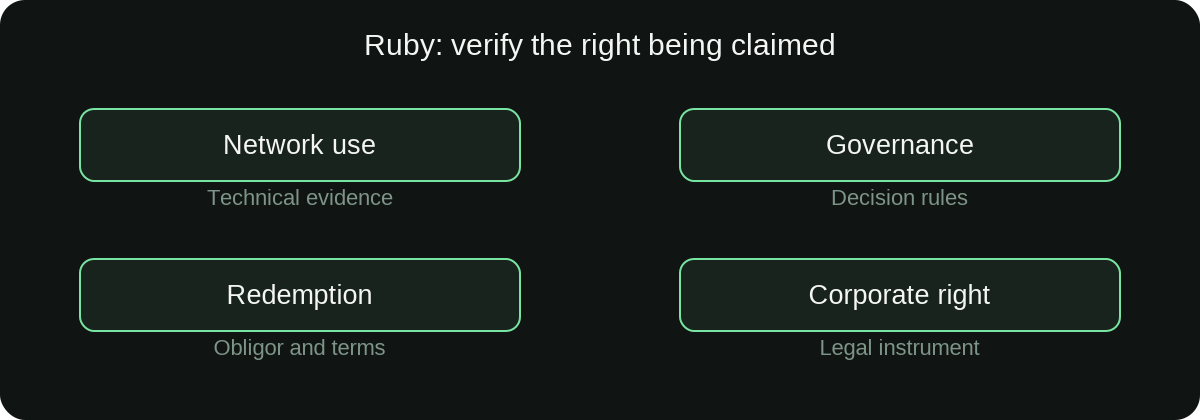
Distinguish the asset from the story around it
Public references use Ruby-related names for different assets. The coinparams network reference includes Rubycoin under RBY, while the Ruby Currency provider profile concerns RBC. A similar name does not merge their networks or histories.
The separate Ruby price article explains how to choose the correct quotation. This guide addresses the preceding project assessment: what the asset is, which claims are supported and whether a custody arrangement fits the intended use.
Begin from the original acquisition or official project context, not a social-media logo. Record the name, ticker, chain or contract, source date and legal entity where one is claimed.
Ask what ownership means in this particular system
Owning a native coin or token can enable network activity or other defined functions. It does not automatically confer equity, voting rights in a company or a claim on physical property.
If a Ruby project advertises backing, identify the obligation. Who owes what to the holder, under which terms and through which redemption procedure? A statement that an asset has utility is different from an enforceable promise to exchange it for cash or goods.
For a gemstone-related claim, ask how custody, verification, insurance and redemption are documented. Do not infer any of those arrangements from the Ruby name alone. This article does not assert that a particular Ruby asset has such backing.
| Claim category | Evidence that would address it |
|---|---|
| Network function | Current technical documentation and observable operation |
| Governance right | Defined voting rules and eligible proposals |
| Redemption claim | Identified obligor and enforceable terms |
| Reserve assertion | Relevant scope, date and independent evidence |
| Corporate ownership | Applicable legal instruments, not token branding |
The point is to evaluate the right promised, rather than collecting unrelated positive statements about the project.
Identify who is making each claim
A project's issuer, a news publisher, a price service and a reseller can all discuss the same name for different reasons. Their statements carry different scope and incentives.
The Ruby Currency website's about page describes publishing and analysis activity. Do not automatically interpret an article on a branded domain as a statement by the issuer or a guarantee from a reserve custodian.
Look for author, date, source links and the distinction between reporting and promotion. An affiliate review may still contain useful information, but a payment relationship should not become evidence of technical support or financial strength.
Where claims conflict, keep the original source and identify the exact disagreement. Repeating the claim across many pages does not create independent confirmation if they all trace back to one unsupported statement.
Choose custody around actual compatibility
A wallet is suitable only if it supports the relevant chain, asset and operations. Receiving, viewing, signing and recovering are different capabilities. A display-only entry should not be mistaken for a tested sending function.
For a native asset, investigate the network and wallet version. For a contract token, verify the chain and identifier. A wallet supporting one Ruby-named asset may have no relationship to another.
Do not download a wallet solely from a direct message. Authenticate the release source and any verification information. If an old application is the only apparent option, investigate its maintenance and operational risks before exposing signing secrets.
For existing holdings, preserve original backups and acquisition records. A person offering to restore access should explain a method that does not require you to hand over the keys controlling unrelated assets.
Evaluate practical utility without assuming investment returns
A useful function should be described in terms of who uses it, what action it enables and why the token is required. A roadmap or marketing example is not the same as evidence of current adoption.
Check whether the proposed benefit accrues to the holder. A project can provide a working service without making its token a claim on revenue. Conversely, a token price can rise temporarily without demonstrating sustainable use.
For a proposed purchase, separate utility, market access and affordability of loss. A coherent product explanation does not eliminate contract, custody, liquidity or counterparty risk.
Avoid ranking Ruby assets by unit price alone. Supply definition, holder rights and available markets differ. Comparing nominal prices without those denominators adds little to the decision.
Preserve a project-assessment record
Create three columns: established fact, attributed claim and unresolved question. Attach a dated source to each. This keeps an issuer statement from gradually becoming an assumed independent finding.
For an Indian user, preserve the actual acquisition, transfer and disposal records. Legal and tax assessment depends on transaction facts and applicable rules, not whether a project calls its units currency, points or digital property.
A project using Indian branding or accepting rupee-linked payments is not thereby authorised or endorsed. Verify the relevant operator's status and service terms separately. No such certification is supplied here.
A reasonable research outcome can be to defer a custody or purchase decision until one specific issue is answered. The aim is a defensible understanding of the asset, not a confident verdict manufactured from incomplete information.
Frequently asked questions
Does a community administrator have authority to change holder rights?
That depends on the actual governance and legal arrangements. A chat role alone does not establish contractual authority. Request the applicable rule and authenticated decision record when a material change is claimed.
Can a company registration prove that token reserves exist?
No. Registration can establish an entity's existence within its scope. Reserve existence, ownership and holder access require different evidence, and should not be inferred from a registration number.
Should an old whitepaper be deleted when a new one appears?
Retain both with dates. The historical document helps explain the terms and claims available when a decision was made, while the newer version can be assessed for specific changes.