 Coin Price India
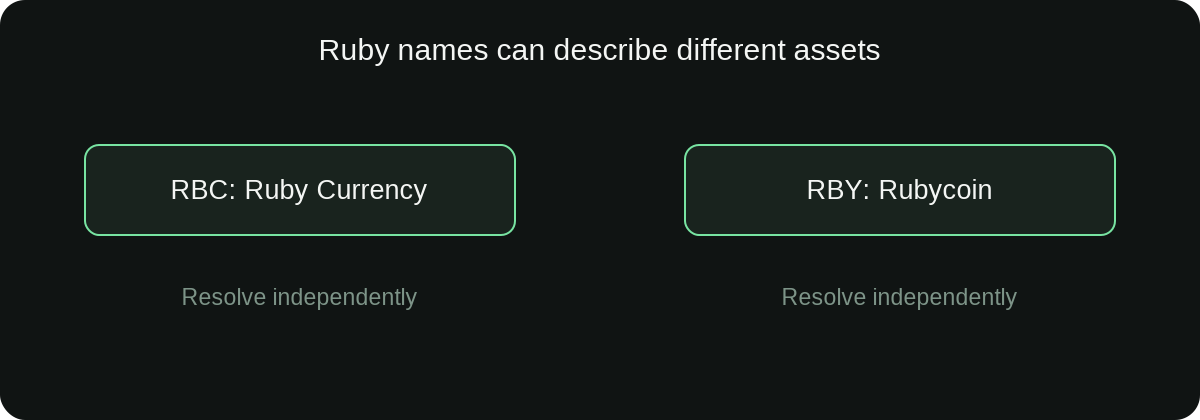
There is no single price for everything called Ruby Coin. Ruby Currency pages use RBC, while Rubycoin is associated with RBY; other similarly named assets may have separate issuers and networks. Resolve the identity before converting any quotation into Indian rupees.
Why the name is not a sufficient identifier
A search query is a discovery tool, not an asset registry. Capitalisation, spacing and a red gemstone logo do not establish that two results describe the same holding. Even matching tickers can be reused on unrelated networks.
For comparison, Coinbase maintains a Ruby Currency price profile, while the open-source coinparams network reference separately identifies Rubycoin with RBY. These references illustrate an identity distinction; neither is proof of a current accessible Indian trading venue.
Start with the evidence from your acquisition. A purchase confirmation or wallet transaction should establish the asset more precisely than a later keyword search. If it does not, the missing identification is the problem to solve before pricing.
Build an identity card for the holding
Record the project name, ticker, native chain or token contract, provider asset ID and acquisition source. For a native coin, use the relevant chain identifiers rather than inventing a smart-contract address. For a token, record its network alongside the contract.
Add the date and source of each identifier. A historical project page can explain an old balance without establishing that its wallet, exchange or support channel remains operational. Version changes should be recorded rather than silently folded into one name.
| Field | Why it belongs in the record |
|---|---|
| Project and ticker | Establishes the intended label, subject to duplication |
| Chain or contract | Connects the label to a technical asset |
| Provider asset ID | Shows which series a price service supplies |
| Acquisition evidence | Connects your balance to that asset |
| Market and date | Establishes what the quotation actually observed |
A completed identity card prevents an INR conversion from valuing the wrong Ruby asset with impressive numerical precision.
Distinguish a publisher from a project operator
The name of a website can imply more than its role supports. The Ruby Currency about page describes a news and analysis publishing service. That distinction matters when a reader encounters educational articles or project summaries under the domain.
A publisher can explain a token without issuing it, holding its reserves or guaranteeing its sale. Conversely, a project's own terms can describe its intended model without independently proving backing or operational performance.
Ask who is speaking and what the statement establishes. An editorial description, issuer promise, exchange market record and blockchain transaction are different evidence categories. Avoid treating the strongest claim from each as if they collectively guarantee a single product.
This is especially important for words such as stable, backed or guaranteed. Those labels require a defined obligation, enforceable terms and relevant supporting evidence. A name associated with a gemstone does not establish ownership of physical gems or a redemption right.
Match the quotation to the correct economic question
After identification, determine whether you need a reference value, an acquisition cost or a sale estimate. A provider's last recorded price can help with a labelled historical observation. It does not automatically answer what a buyer will pay for your quantity today.
For an indicative conversion, multiply a matching asset price in its quote currency by the relevant INR exchange rate. Record the two observations separately. If the source price is stale or the market unidentified, the output inherits that limitation.
A sale estimate needs more: deposit eligibility, a functioning market, sufficient buying interest, trading costs and settlement access. If these are unresolved, do not describe the converted result as withdrawable rupees.
For an untracked Ruby market, displaying zero is also potentially misleading. Zero implies a measured value. Missing reliable evidence is better recorded as unavailable, with an explanation of which input could not be established.
Resolve conflicting pages without averaging them
Suppose one provider shows a Ruby price and another displays a different value or no market. First compare the identifiers and timestamps. They may describe different assets, different versions or observations from different dates.
Next compare methodology. A market average, last trade and internal programme rate do not measure the same thing. Averaging them would conceal the disagreement rather than improve accuracy.
If the identifier matches but the data differ, preserve both records and investigate the contributing markets. A recently edited webpage may still carry an old underlying trade. The page's publication date does not refresh the economic observation.
A useful conclusion can be narrower than a single price: the asset is identified, but a current sale value remains unverified. That gives the reader a concrete next task instead of an unjustified number.
Check custody before moving an old balance
A wallet displaying Ruby units may be reading a saved local balance or an obsolete network connection. Verify the relevant chain state and wallet support without disclosing private keys to an online checker.
Do not send a test deposit to a platform until its asset and network requirements are confirmed. A familiar ticker on the deposit screen can still refer to a different coin. Recovery after a wrong-network transfer is uncertain and provider-dependent.
Retain acquisition statements and the evidence used to identify the holding. Indian reporting questions should be addressed using the actual asset and transaction history, not whichever Ruby chart ranks highest in search.
Frequently asked questions
Can a price service rename an asset without changing my wallet balance?
Yes. A provider may update a label while the underlying holding remains unchanged. Keep its asset ID and historical labels so you can distinguish a display update from an actual migration or transaction.
Does a Ruby-themed domain establish ownership of the token trademark?
A domain alone does not establish corporate ownership, trademark rights or authority over a blockchain asset. Those questions require the relevant legal and project records rather than inference from a matching name.
What should I ask the person who originally sold me Ruby units?
Request the precise asset identifier, transfer record and written terms of the sale. Avoid accepting another screenshot as a substitute for those records, and do not pay additional money simply to receive basic transaction documentation.