 Coin Price India
PAI does not uniquely identify one cryptocurrency. Several projects use those letters, so a price or wallet result must be tied to the full project name, chain and asset identifier before you use it. Choosing the first search result can mean researching a different investment.
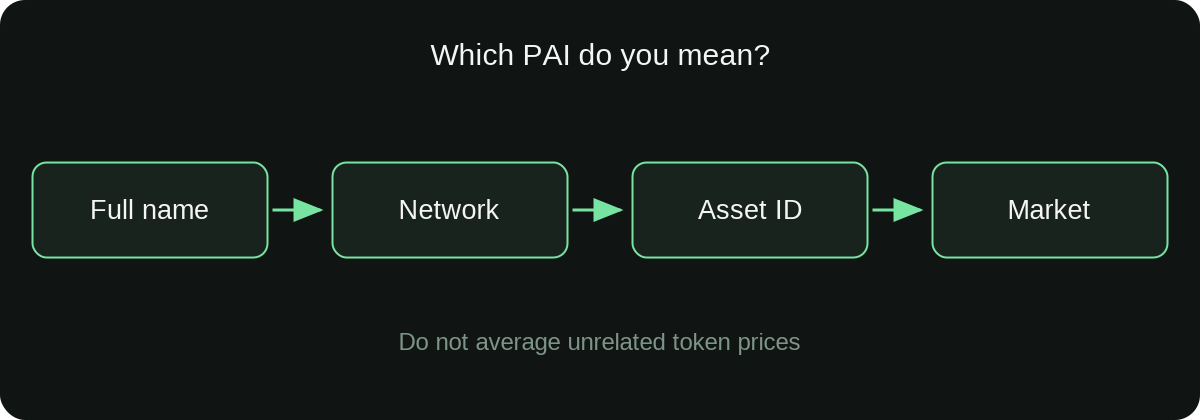
Identify the project before choosing the chart
Search results can include ParallelAI, Panther AI, Parabolic AI and older Project PAI references. These names concern different projects, not interchangeable spellings of one coin. A page carrying PAI in its title can be internally consistent while answering the wrong question for your holding.
For example, the ParallelAI INR page and Parabolic AI INR page identify different assets. Their existence illustrates ticker ambiguity; their displayed prices should not be combined into a PAI average.
Begin with the source of your original asset reference. If you already hold units, use the purchase record and wallet details. If you are responding to a project announcement, locate its full identity before searching for a quotation.
Distinguish AI marketing from token rights
A project using AI in its name may describe software access, computing services, trading tools or a community theme. Those descriptions do not automatically create a financial claim for token holders. Ask what the token actually permits and what evidence shows the service works.
For a proposed utility, separate access rights, fee payment, governance and possible promotional rewards. A service can function while the token's market price falls. Conversely, a price rise does not establish that the advertised software has been adopted.
Do not assume an AI-themed token is linked to a better-known AI company. Verify a claimed partnership through the other party's own announcement and scope. A copied logo or mention in a directory is weaker evidence.
Build an asset identity record
| Field | Why it matters for PAI |
|---|---|
| Full project name | Separates unrelated uses of the ticker |
| Network | Determines wallet and transfer compatibility |
| Exact identifier | Distinguishes the deployment from copies |
| Project source | Connects the identifier to the intended issuer |
| Version or migration | Explains whether old records remain comparable |
| Observation date | Prevents a historical description becoming a current assertion |
Keep this record separate from the market quote. The identity should not change simply because one provider reports a higher price. If a provider maps the ticker incorrectly, resolve that discrepancy before adding its numbers to your spreadsheet.
A contract imported into a wallet only changes what the wallet recognises or displays. It does not authenticate the issuer. Treat token searches as discovery tools, not as a verification service for every result.
What to check on a PAI market page
Inspect the full name, network, market sources and update time. Determine whether the price is based on one venue, an aggregate or a conversion. A small-volume pool can create a quotation that is unsuitable for valuing a larger holding.
Missing fields need careful treatment. An absent circulating-supply estimate is not the same as zero units in circulation. A missing market cap is not proof that every holder's balance is worthless, and it is not an invitation to invent a supply figure.
For an actual transaction, request or inspect the quote for your quantity. Identify all steps in the route, including any change of asset or network. The displayed per-unit value is only one input to the final amount received.
Do not transfer based on the ticker alone
A platform supporting one PAI asset does not necessarily accept another. Compare the exact deposit instructions with the asset you hold. A chain mismatch can remain a problem even when both screens show the same three letters.
Verify the receiving service and any current maintenance or minimum requirements. Do not send a test merely to discover whether an obviously different asset is accepted. A limited test belongs after the identity and compatibility checks, not before them.
If a migration is proposed, preserve the old and new identifiers and the applicable terms. Do not treat an unsolicited token allocation as the replacement for your existing asset without primary evidence connecting the two.
Evaluate permissions and liquidity separately
A token's market availability does not settle the permissions built into its contract. Where relevant, examine minting, transfer restrictions, administrative control and upgrade arrangements. Use the deployed version and recognise the limits of automated scans.
A favourable contract assessment also does not establish a dependable exit. Inspect bids, pools and withdrawal conditions separately. These checks address different risks and should not be compressed into a single safety score.
For a new investor, complexity is itself a practical consideration. If understanding the route requires more ongoing monitoring than you can provide, a decision to continue researching without buying can be reasonable even when no specific wrongdoing is established.
Keep the Indian cost and recordkeeping task clear
An INR converter does not necessarily represent an INR trading market or a supported Indian bank payment. Identify the actual funding and exit arrangements for your account. Do not assume foreign availability means local permission for every product.
Record the asset name with transaction identifiers, quantities, consideration and fees. This matters particularly when later searching old records: a ledger containing only PAI can become ambiguous if you interact with more than one project using the symbol.
When requesting professional tax advice, provide those identifiers rather than only a portfolio total. A clear asset record reduces the chance that a reporting tool imports the wrong market history or valuation.
Frequently asked questions
Can I rename the token locally in my wallet to avoid confusion?
A local label can help organisation, but retain the original ticker, chain and identifier in your records. Renaming a display does not change the underlying asset or its compatibility.
Should I use a provider's logo as the primary identifier?
No. Images are easy to copy and can be outdated. Use the exact asset details and an appropriate project reference before relying on visual branding.
What if an old spreadsheet contains only PAI and an amount?
Reconstruct the identity from order exports, wallet transactions and source dates. Do not choose whichever current PAI price produces the most favourable valuation.