 Coin Price India
A Ruby price labelled today may still combine old descriptive text, an incomplete feed and a different asset mapping. Before using it, verify the Ruby identity and determine which fields actually have current market evidence. A recent page visit is not a recent trade.
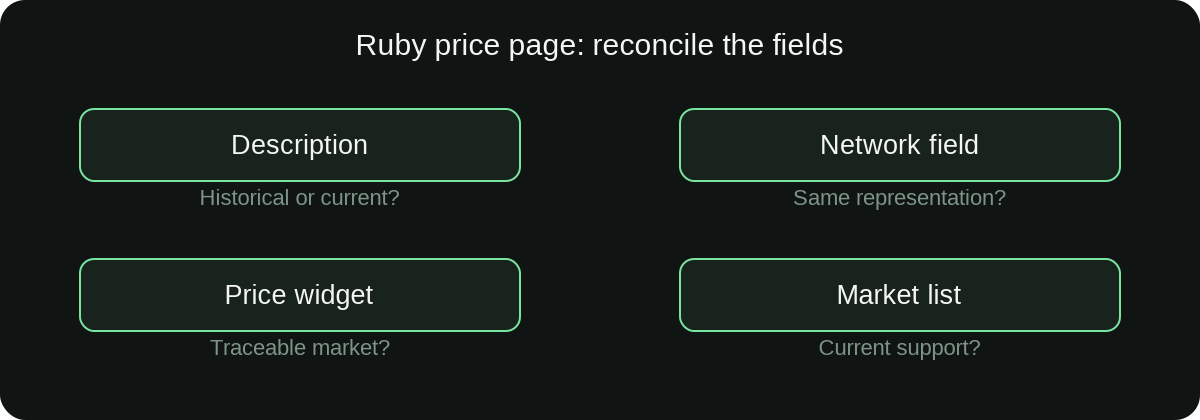
One page can contain several kinds of information
A price page often combines an editorial description, historical statistics, a dynamic widget and network metadata. Those components may be maintained through different systems. Their proximity does not establish that they were updated together.
The retrieved Coinbase Ruby Currency page illustrates why reconciliation matters: its descriptive and network fields require checking rather than being treated as one unambiguous technical specification. It also states that the asset is not tradable on Coinbase.
The Ruby price identification guide handles RBC versus RBY and other naming problems. Here the task is narrower: after choosing the intended asset, determine whether today's displayed number is fit for your purpose.
Do not turn a provider's informational coverage into an exchange-support claim. A page can exist to display third-party data without offering that asset for purchase or deposit.
Audit the page field by field
Save the complete URL, retrieval time and provider asset name. Then separate the headline quote from the description, supply fields, market list and network table. Record any conflict rather than resolving it by choosing the most convenient field.
For example, technical prose referring to one network and a table referring to another need explanation. They might reflect a version change, a mapping problem or stale content. The page alone does not establish which explanation is correct.
| Field | Evidence needed before use |
|---|---|
| Headline price | Matching asset, price method and observation time |
| Percentage change | Defined comparison interval and usable starting value |
| Network table | Current asset representation and authenticated mapping |
| Historical high | Comparable denomination and provider series |
| Market availability | Current venue evidence, not a general description |
The useful conclusion may be that some fields are usable while others remain unresolved. A responsible update does not need to accept or reject the entire page as a single block.
Check whether the quote has a market behind it
A current numerical field should be traceable to a relevant observation or methodology. Inspect the contributing markets where the provider makes them available. Identify whether the number is a last trade, composite or another reference.
If a market list is absent or stale, do not substitute a general claim that the token trades on many venues. That statement may belong to an old description and may not identify any route accessible today.
The CoinMarketCap Rubycoin page is a separate provider series associated with another Ruby context. It should not be used to fill missing RBC data unless the underlying asset match has been independently established.
A comparison provider is useful when it corroborates a matching observation. It becomes misleading when its different asset happens to have the same keyword and is silently treated as confirmation.
Test freshness with repeated observations
Record a first observation and a later observation, keeping the asset and source fixed. Compare the underlying trade or data timestamp where supplied, not merely the browser's clock.
An unchanged price can be legitimate if no relevant trading occurs. A moving price can also be misleading if only the conversion currency changed. Distinguish movement in the source asset from movement introduced by an INR display.
Look for missing values, static descriptions and unavailable market fields. These signals do not prove the asset is worthless; they limit what the page establishes. Label a field unavailable instead of interpreting it as zero.
Do not claim a live feed merely because the page animates or displays a loading indicator. The operational question is whether new, identified market observations are reaching the field used in your calculation.
Keep revisions visible in a publication
When comparing Ruby updates, check the reported time, timezone, asset identity and price source. Separate the time the article was edited from the time the economic observation occurred.
When a source changes its mapping, retain a note describing what changed. Do not splice incompatible series together and calculate a return across them without adjustment or explanation.
If reliable data are unavailable, use an explanatory status statement rather than a made-up current price. Readers benefit from knowing which input failed and where to look next. A false number is not a better answer merely because the search includes today.
Avoid daily price predictions disguised as updates. A lack of current data cannot support precise support, resistance or recovery targets. Even a valid quote would require additional evidence for a market-outlook claim.
Connect the observation to an Indian reader's decision
A reference INR figure is useful for orientation, but a sale requires a compatible deposit route, accessible bids, quantity and settlement. The page's own non-tradability statement is a reminder that information and execution are separate services.
Do not advertise bank withdrawal capability from an INR calculator. Check the actual provider, account conditions and applicable obligations before planning a transaction.
Preserve the original observation and any executed trade separately. For later reporting, an estimated portfolio mark and realised proceeds are different records. Professional advice should use the actual history rather than a corrected website field alone.
A trustworthy Ruby price update therefore provides a source-specific status, not a universal cash promise. Where the evidence ends, the article should identify the boundary explicitly.
Frequently asked questions
Can a zero daily change be accurate when the market is inactive?
It can reflect an unchanged reference, but it does not prove active trading or stable value. Check whether the calculation has a valid starting point and whether new observations occurred.
Should I delete a saved quote if the provider later corrects it?
Keep the original as a dated observation and attach the correction. This preserves the reason a prior estimate differed without continuing to present the old field as current truth.
Does a screenshot prove what another user could trade at that moment?
It proves only what the screenshot reliably records. Account eligibility, quantity and execution conditions remain separate, and the image may not include the underlying market timestamp.