 Coin Price India
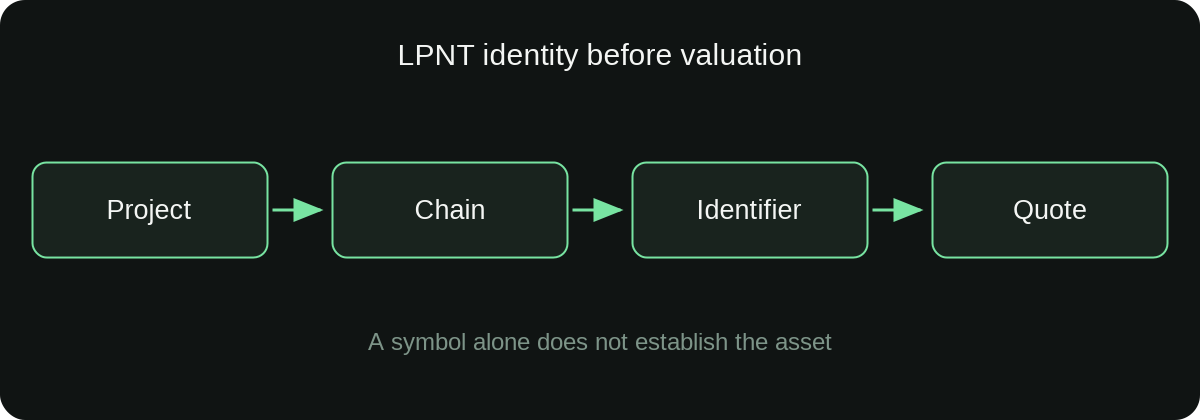
An LPNT quote is meaningful only after you identify Luxurious Pro Network Token, its chain and the market supplying the number. A familiar ticker does not establish that every similarly named token is the same asset. Start with identity before deciding whether a price is cheap, expensive or usable.
What LPNT documentation describes
The project's whitepaper describes LPN Token in the context of Luxurious Pro Network Group. Treat product aims and utility descriptions as project statements, not independent proof that every proposed service is operational or authorised for Indian users.
The LPNT project repository profile provides another identity reference. Its description links the LPNT and LPN Token names. A public repository or profile is useful for tracing materials, but it does not itself establish market liquidity or the safety of a downloaded application.
Write down the full name and source date before comparing prices. If a source abbreviates the name to LPN, verify the relationship instead of assuming that three letters always point to this project.
Match the contract and chain to the quote
The same token name can appear on more than one chain, through a representation or through unrelated copying. A matching hexadecimal address on two networks is also not sufficient evidence of a valid cross-chain relationship. Each network has its own state and deployment context.
Begin from the project's documented identifiers and compare them with the market and receiving service. Where a representation or migration is claimed, identify the mechanism and current instructions. Do not send tokens across chains merely because the logos match.
Avoid treating a contract address supplied in a comment as authoritative. A copied symbol can look convincing in a wallet search. The identification task is to connect the source, chain and asset, not just find any result bearing LPNT.
A price can be present while execution remains difficult
A provider can retain a last known trade even when recent activity is sparse. The number may be useful as a historical observation without being a reliable estimate of what you can receive for your quantity today.
Examine the recent trade time and the market's bid and ask. Then inspect cumulative depth for the amount you intend to transact. Price, reported volume and executable liquidity answer related but different questions. A large displayed portfolio value cannot replace that inspection.
If there is no usable quotation, leave the value unresolved. A blank field should not become zero, and an old quote should not become a fresh one merely because a page now displays a new date.
Compare sources by their methods
| Source feature | What to check |
|---|---|
| Asset identifier | Whether it matches the intended LPNT deployment |
| Quote source | One venue, a composite or a conversion |
| Time | Last trade versus page-update time |
| Currency | USD, USDT or a calculated INR display |
| Market coverage | Whether inactive venues are retained |
| Supply method | Which units are included in any market-cap estimate |
A disagreement is a prompt to inspect these fields rather than average the prices. If one provider uses a stale market and another a recent trade, their mean does not create a better current quote. Keep the incompatible observations separate.
Also inspect whether a percentage change and a headline price use the same comparison window. A rolling 24-hour change differs from a calendar-day close. Rounding can add another apparent discrepancy, especially for small per-token values.
Convert to rupees without hiding assumptions
For a USD quotation, multiply the token amount by the USD-per-token rate and the INR-per-USD conversion. For a USDT pair, use the relevant USDT conversion rather than silently treating the stablecoin as bank dollars.
As a simple hypothetical example, 100 units at a quote of 0.01 USDT and a conversion of ₹90 per USDT yield an indicative ₹90 before costs. These inputs illustrate the formula; they are not LPNT market observations or an expected selling price.
The final rupee proceeds can differ because of execution, trading charges, transfers and conversion spreads. Keep those items visible. A converter estimates a value; it does not provide an Indian bank payout service.
Do not turn utility language into a valuation model
A project describing payment, wallet or trading uses has stated a potential reason for activity. To connect that activity to token value, you need evidence about actual use, the role of the asset and demand relative to supply.
A service can be useful without every token holder receiving a financial claim on it. Check the rights attached to the asset rather than assuming equity ownership, dividends or guaranteed buybacks. A founder presentation cannot supply rights omitted from the applicable arrangement.
Likewise, a security profile is not investment insurance. If you encounter an audit claim, read the report's auditor, scope and version. Do not infer coverage of every app, bridge or commercial promise from a badge attached to one project page.
A useful personal LPNT price record
Maintain an identity row and a market-observation row separately. The identity row changes when a documented version or chain arrangement changes. The market row records the quote, quantity and time for the decision you are making.
For an actual purchase, work backwards from a verified receiving wallet and exit route. For an existing holding, keep acquisition records rather than replacing them with a current display value. This makes investment review and any later Indian tax assessment more supportable.
The point is not to produce a number at any cost. It is to know what your number measures and when it is too uncertain to use.
For the underlying dollar/cent arithmetic, see the currency-unit conversion guide.
Frequently asked questions
Does a displayed INR market cap mean that rupees are held behind the token?
No. Market capitalisation is normally a calculated price-times-supply measure. It does not establish a rupee reserve or a redemption entitlement for holders.
Can I value a tiny residual balance at the headline rate?
You can make a labelled estimate, but check minimum orders and transfer charges before calling it realisable proceeds. A residual can be uneconomical to move.
What if a source changes its ticker label without explaining why?
Keep the earlier observation and investigate the provider's asset mapping. Do not overwrite your record until you know whether the change is editorial or reflects a different asset.