 Coin Price India
An INR-converted MCOIN price is not the full cost of acquiring a usable holding. Work backward from the quantity you want in the final wallet, then include token deductions, quote-currency charges and the verified rupee funding cost. If the route is unverified, the budget remains conditional.
Define the destination before choosing a rate
A target of 100 MCOIN can mean 100 units in an exchange account or 100 units delivered to a compatible personal wallet. Those are different outcomes if withdrawal costs or supported representations differ.
Start by recording the destination asset and network. The M20 Chain website describes the associated ecosystem, while CoinGecko's MCOIN INR page supplies a provider's rupee presentation. Neither source by itself establishes a complete route from an Indian bank to your chosen wallet.
For asset matching, use the separate MCOIN identity article. This article assumes that prerequisite has been resolved and focuses on constructing a quantity-based acquisition budget.
Do not treat a public price page as proof of an INR trading pair, UPI support or account eligibility. Confirm those features with the actual provider before calculating costs as if they were available.
Build the budget backward
Let Q be the quantity you want to receive and D the token deduction required to reach that destination. If a withdrawal fee is deducted in MCOIN, the acquisition quantity may need to be Q plus D.
Let P be the applicable acquisition price in quote-currency units per MCOIN. Add quote-currency costs separately, then convert using the actual funding rate expressed as INR per quote unit. Include other rupee charges only where they genuinely apply.
Illustrative budget = ((Q + D) × P + quote-currency costs) × funding rate + other INR costs.
This compact formula assumes a fixed token deduction, a single acquisition price and the stated fee treatment. Percentage charges, multiple price levels or a different withdrawal mechanism require adjustments rather than blind reuse.
A transparent worked example
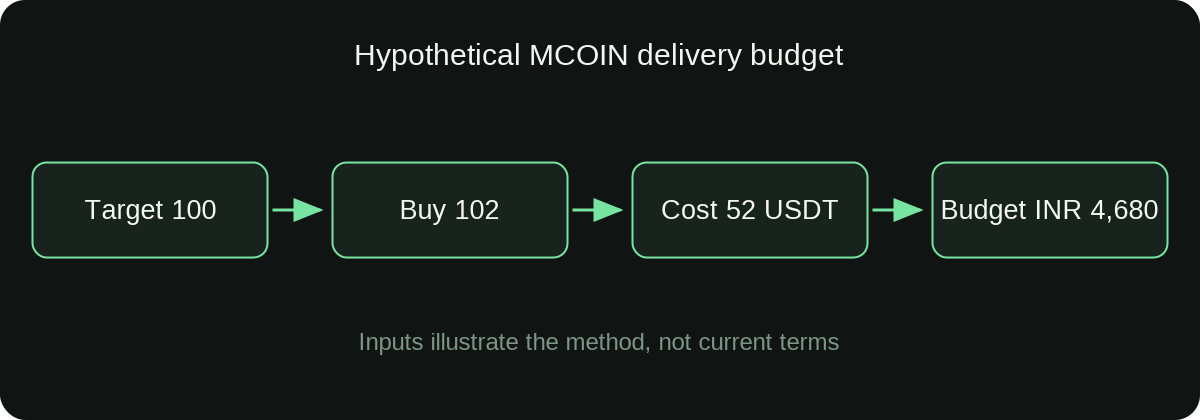
Suppose the target is 100 units delivered. Assume a hypothetical fixed deduction of two tokens, a purchase price of 0.50 USDT per token, one additional USDT of costs and a funding rate of 90 INR per USDT.
The example requires purchasing 102 units. Their purchase value is 51 USDT. Adding the one-USDT cost gives 52 USDT, which at the assumed funding rate costs 4,680 INR before any other applicable charges.
| Budget step | Illustrative calculation | Result |
|---|---|---|
| Required purchase | 100 target units + 2 deducted units | 102 MCOIN |
| Token acquisition | 102 × 0.50 USDT | 51 USDT |
| Add quote-currency cost | 51 + 1 | 52 USDT |
| Rupee funding | 52 × 90 INR | 4,680 INR |
All inputs are invented for teaching the method. They are not current MCOIN prices, provider fees or evidence that this route exists. The information gain is the reproducible backward calculation, not a claim of original market data.
The effective cost is 46.80 INR per delivered unit in this example. Multiplying the target by the headline converted token price alone would miss the deductions and extra cost.
Replace the simplified assumptions with actual terms
Check how each charge is collected. A trading fee might reduce the purchased asset, the quote balance or another fee token. A withdrawal charge might be fixed, variable or subject to a minimum. These differences change the required input quantity.
Check minimum order value, permitted increments and withdrawal minimums. Rounding up the purchase quantity can leave a residual balance; rounding down can prevent the target delivery. Record the expected remainder rather than hiding it inside the unit-cost figure.
For a larger order, use the actual accessible offers rather than one last-trade price. The average acquisition price can change as the order consumes depth. A limit order can cap the price but may not obtain the desired quantity.
If the route includes a transfer of quote currency, confirm that its destination network matches. The existence of USDT on several chains does not make those transfer routes interchangeable.
Funding access and cash-out are separate tests
An Indian resident should verify the provider's current service conditions and applicable local obligations before funding. A successful identity check does not automatically authorise every product, transfer method or third-party payment arrangement.
Do not pay someone else's bank account on the strength of an informal chat promise. Preserve the provider's order record and use authenticated support if details conflict. Avoid moving a transaction outside the agreed procedure to save an apparent fee.
An acquisition budget also does not establish exit value. If you later sell, the relevant inputs become accessible bids, sale quantity, fees and settlement conditions. Reversing the original purchase formula ignores spread and changed market conditions.
Keep acquisition planning and disposal planning in separate worksheets. This makes it easier to see whether a low advertised buying price is offset by poor withdrawal support or limited selling demand.
Maintain evidence for reporting and later decisions
Save the funding transaction, executed trade, fee breakdown, withdrawal and receiving transaction. Record the actual asset and network rather than only the marketing name. Preserve original statements before transforming them into a spreadsheet.
For Indian tax analysis, distinguish acquisition cost, transfer events, proceeds and any withholding records. Do not classify every provider deduction as a tax, or treat withholding as the final liability without checking the applicable facts.
A qualified adviser can use these records to assess the transaction. A generic crypto article cannot determine the treatment of every cross-border arrangement or certify a platform's permission to serve you.
The finished budget should therefore state both its amount and its conditions: target quantity, verified route, rate observation time, fee assumptions and unresolved items. That is more useful than a precise rupee figure detached from a deliverable outcome.
Frequently asked questions
Can I use yesterday's funding rate for a purchase budget?
You can use it for a clearly labelled preliminary estimate, but refresh it before committing. Retain the earlier scenario separately so a difference between the estimate and final cost can be explained.
What if a fee is paid from an existing wallet balance?
It still has an economic cost even if it does not appear in the new funding amount. Record the asset quantity consumed and the valuation method rather than treating the transaction as free.
Should I combine several people's purchases to meet a minimum?
Do not assume that is permitted or operationally simple. Mixed ownership introduces recordkeeping, custody and provider-rule questions. Establish those arrangements before treating aggregation as a cost-saving technique.