 Coin Price India
In a crypto search, TESTICLE can refer to a Solana meme token, but several similarly named tokens exist. A usable price must identify the exact mint and the market behind it. A matching joke name or ticker is not enough to choose an asset or estimate a sale.
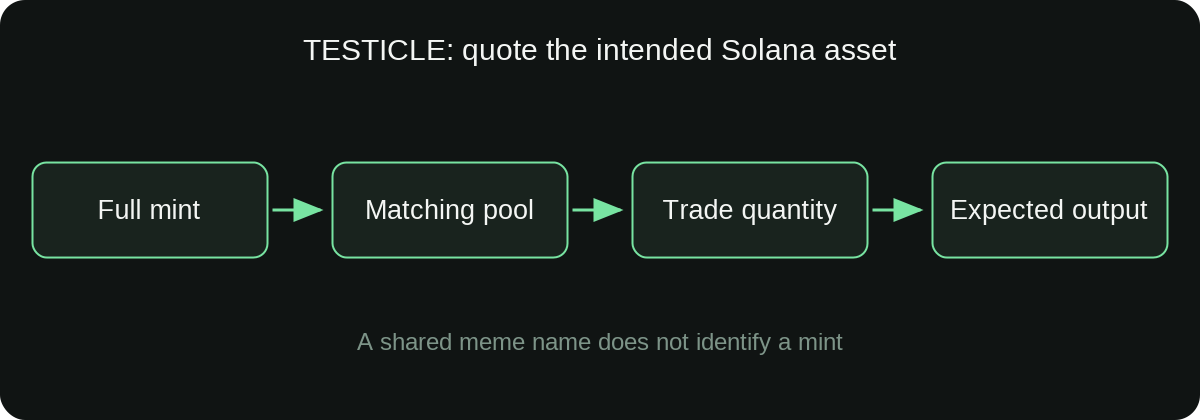
What the available references identify
The CoinGecko TESTICLE profile places an asset under its testicle provider ID. A corresponding Solana Compass token page identifies a particular mint. These are market and network references, not endorsements or proof that every same-name token is equivalent.
Searches also surface other mints using variations of the name. Do not average their prices or combine their histories. Even a one-character difference in the mint can identify a different asset.
This article concerns crypto-market identification, not a physical commodity or a medical service. The financial task is establishing what the holding is and whether a real market supports the intended quantity.
Use the mint rather than the display name
Solana's token documentation explains the distinction between a mint and token accounts. A mint identifies the token type; an account records units held in a particular account context.
Compare the complete mint through authenticated references. A shortened address in a screenshot is useful for orientation but insufficient when distinguishing lookalikes. Do not rely on the first and last few characters alone for a transaction decision.
The token account, pool address and mint are different identifiers. Pasting whichever address appears on a page into another tool can produce a plausible result for the wrong object.
Save the provider ID, mint, quote asset and market together. This creates a traceable record rather than a price detached from its technical identity.
Explain why prices disagree before choosing one
Different pages can use different pools, timestamps or aggregation methods. Some may describe another mint entirely. A large difference is a reason to inspect the inputs, not to choose the highest number as your portfolio value.
Check whether the quote is in SOL, wrapped SOL, USDC or another asset. A token's dollar display can depend on an additional currency conversion. Changes in the quote asset can affect that display even when the token's pair price is unchanged.
| Disagreement | First check |
|---|---|
| Same name, very different price | Full mint identity |
| Matching mint, different update | Market and observation time |
| Similar price, different market cap | Supply definition and provider method |
| Tiny test succeeds, large sale differs | Pool depth and price impact |
The conclusion should identify the cause where evidence permits. If it cannot be resolved, keep the observations separate rather than manufacturing a consensus figure.
Price impact is central to a small meme-token market
A pool quotation is quantity-dependent. The output for a large swap cannot be inferred by multiplying a tiny-trade price across the whole holding. Reserves, route and fees affect the result.
Request a quote for the intended quantity and inspect the expected output, price impact and minimum received. Treat that quote as conditional on state and execution timing, not a reservation of the displayed amount.
Slippage tolerance is not a prediction of loss and does not create liquidity. Raising it can permit a worse execution than the user intended. A failed quote may be a useful signal to investigate, rather than a reason to remove every protection.
Volume also has limits. Reported past trading does not show that independent buyers will absorb your position now. Concentrated holdings, rapidly changing liquidity and attention-driven demand can make exits uncertain.
Inspect permissions without confusing them with investment quality
Mint and freeze authorities, token-program features and pool controls deserve examination. A scanner can help identify relevant settings, but its result depends on scope, timing and methodology.
Do not infer specific permissions for this token without checking its actual current mint and programme. Equally, disabled authorities would not prove adequate liquidity, honest promotion or a sustainable price.
A third-party grade is an analytical label, not insurance. Read what it measures. Code or structural checks cannot establish every off-chain relationship, holder intention or future market event.
Wallet interaction introduces its own risk. Read the transaction being requested and avoid signing an unexplained approval or transfer simply because the interface uses a familiar token image.
Keep the Indian cost and recordkeeping layer separate
An INR reference requires a documented conversion path. It is not evidence of a direct Indian market, banking access or platform permission. Verify the actual provider conditions before treating a route as available.
Budget network fees, acquisition or sale costs and the relevant settlement deductions. A low nominal token price does not make the complete transaction inexpensive, particularly for a small position.
Maintain acquisition records, mint identifiers, swap transactions and the final amounts received. Review Indian reporting and tax questions using those facts rather than relying on a meme-token label as a legal category.
No exact live price or target is given here. Without synchronised market and route verification, a precise number would obscure the uncertainty that matters most to the intended trade.
Separate a token’s social attention from its market infrastructure. A rapidly growing discussion can coexist with a single fragile pool. Record the number and independence of usable routes rather than assuming that many mentions create many buyers.
A transaction preview should identify all assets being sent; do not assess a signature request from its token-name label alone.
Frequently asked questions
Does hiding an unwanted token in a wallet remove it from the blockchain?
No. Hiding generally changes the interface. It does not by itself burn, sell or transfer the asset, and should not be recorded as a disposal merely because the entry disappears from view.
Can a token's website be changed after I first inspect it?
Yes. Metadata and linked resources can change depending on their controls. Keep dated references and evaluate a new destination independently instead of assuming permanent continuity.
Should I share a screenshot of my wallet to ask about the mint?
Prefer the public mint identifier and a redacted description of the issue. A full screenshot can expose unrelated balances or personal context that is unnecessary for asset identification.