 Coin Price India
A PLC Ultima price must first be assigned to the correct asset: historical PLCU, PLCUC or the newer PLCU chain. After that, distinguish a quoted value from proceeds obtainable for your actual quantity. A price page alone does not establish either identity or liquidity.
Put the 2023 name change beside the quotation
MEXC's January 2023 migration notice explains that the original PLCU would be renamed PLCUC while a new PLCU used a new chain. A record created before that transition therefore needs historical context.
Do not compare an old PLCU high with a newer asset's quote merely because the ticker looks unchanged. Determine how the data provider mapped the transition. If the history cannot be reconciled, do not describe it as one continuous investment return.
The same issue applies to balances. An old product statement, an exchange balance and a wallet holding may not describe identical units. Preserve the original asset name and date instead of rewriting every record under the current search term.
Use a hierarchy of values rather than one portfolio number
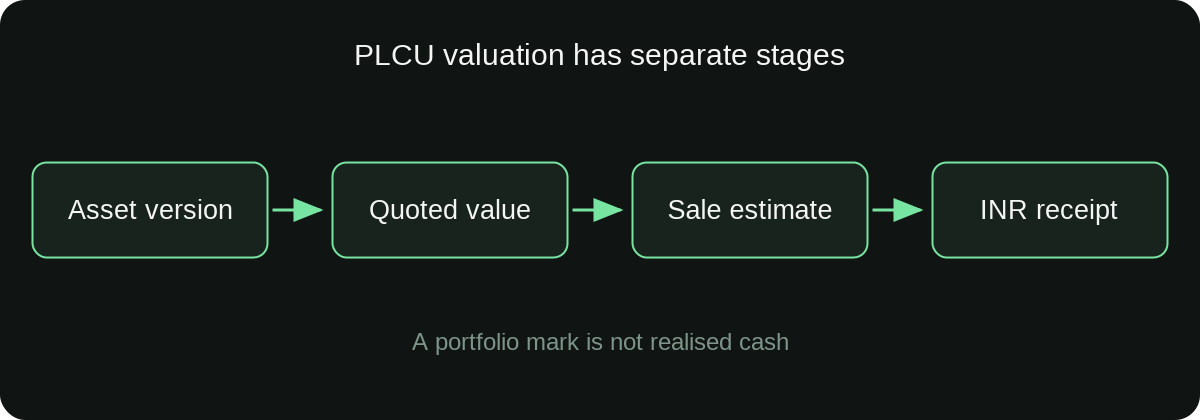
For a real holding, several values can be relevant at once. Acquisition cost records what you paid. A reference quotation supports an indicative estimate. An executable sale quote concerns a particular quantity. Net cash received measures a completed exit after its costs and conditions.
| Value | Evidence required |
|---|---|
| Historical acquisition | Payment and completed purchase record |
| Indicative current mark | Identified asset, source and observation time |
| Proposed sale proceeds | Usable bids or a complete quote for the intended quantity |
| Net destination amount | Actual conversion, transfer and payment deductions |
| Completed INR receipt | Sale records connected to the bank credit |
These values can differ without any arithmetic error. The mistake is presenting one as though it answers all the questions. In particular, a wallet display should not be called withdrawable bank money.
Investigate missing or contradictory provider data
The CryptoRank PLCU/INR page surfaced inactive or unavailable-current-rate information alongside historical material during research. A page with that combination needs careful reading rather than a copied number under a fresh date.
Check the last actual trade and market coverage behind the quotation. Page-update time can differ from price-observation time. A generic converter table may also remain on a page when no usable current quote is established.
Do not replace an unavailable value with zero or with the most recent old number without a label. Each state conveys different information. If providers disagree, compare their asset mapping, time and venue inputs before choosing a value.
An exchange list can outlive the market
A historical listing is evidence that a service was announced at a particular time. It is not permanent proof of deposits, trading or withdrawals. Check the relevant service directly before sending existing coins or buying funding assets.
EXMO's May 2024 delisting notice documents the end of PLCU and PLCUC services at that venue. An older tutorial naming it cannot override the later notice. This is a dated example, not a complete current census of all markets.
A venue offering a page about a coin can also be providing information rather than execution. Verify the actual pair, network, account eligibility and service status. A familiar exchange logo does not supply missing support.
Estimate proceeds from the actual order size
For an order-book sale, inspect cumulative bids rather than only the last price. A small trade can establish a print without demonstrating demand for your whole holding. For a routed swap, inspect the full output and each asset transition.
As a hypothetical example, suppose half a position could be sold at one quoted level and the remainder only at a lower level. The weighted proceeds would fall below the top bid multiplied by the total quantity. That arithmetic does not predict PLCU trading; it explains why quantity matters.
A limit order constrains the price you accept but may remain unfilled. It cannot create liquidity. Do not interpret an unexecuted order at a high price as evidence that your position has that realisable value.
Keep INR conversion as a separate step
A PLCU/USDT sale results in a stablecoin balance under that trade's terms. It does not automatically produce rupees. Check the permitted conversion and payment route, including the asset network and receiving conditions.
For an indicative estimate, multiply the relevant sale proceeds by the conversion rate and then account for the remaining charges. Record the rate's direction and time. Do not treat a USD display and a USDT market as automatically equivalent inputs.
A completed bank payment is a separate record. Keep it linked to the trade and original acquisition. This supports source-of-funds explanations and professional tax review without pretending a price calculator determines the tax treatment of every transaction.
Do not use promised rewards to fill a valuation gap
A Farm, Minter or migration arrangement can display future entitlements or scheduled distributions. Those are not necessarily transferable units already available for sale. Identify the agreement and delivery state before including them in a current holding total.
More units also do not guarantee more rupees. Paid product costs, market price changes and exit conditions can alter the financial outcome. A reward schedule is not a substitute for a current sale quotation.
If a person offers a replacement allocation or demands another payment to release old units, verify that claim independently. An investment loss does not make a new offer trustworthy, and a recovery promise should not determine the value assigned to the original balance.
A practical valuation record for an existing holder
Maintain separate columns for asset version, quantity, transferability, acquisition cost, indicative mark and executable exit estimate. Attach the underlying sources and dates. Leave a column unresolved when evidence is missing rather than forcing a precise total.
Update observations without destroying the earlier record. If a source changes its mapping or a market closes, explain the change. That produces a useful history of what could be established at each point.
The answer to a PLC Ultima price search should therefore be a correctly identified and appropriately qualified value. Where the evidence does not support a live rate, a transparent limitation is more accurate than a number chosen to satisfy the headline.
Frequently asked questions
Can I treat an unfilled sell order as a completed disposal?
No. Separate the instruction from executed fills. Keep any partial execution and remaining balance distinct when reviewing the position or preparing records.
Should I value locked units and freely transferable units identically?
Do not assume identical realisability. Record the lock or entitlement conditions and the intended valuation purpose; a common display price cannot remove those constraints.
What if the exchange account and my old spreadsheet use different names?
Preserve both references and reconcile them through transaction dates and documented migration history. Do not rename the old record until the relationship is established.