 Coin Price India
Today's MCOIN number should be traceable through an identified market, provider calculation and observation time. A freshly loaded webpage can still serve cached or incomplete data. Keep the price source separate from the interface that displays it before making a portfolio or trading calculation.
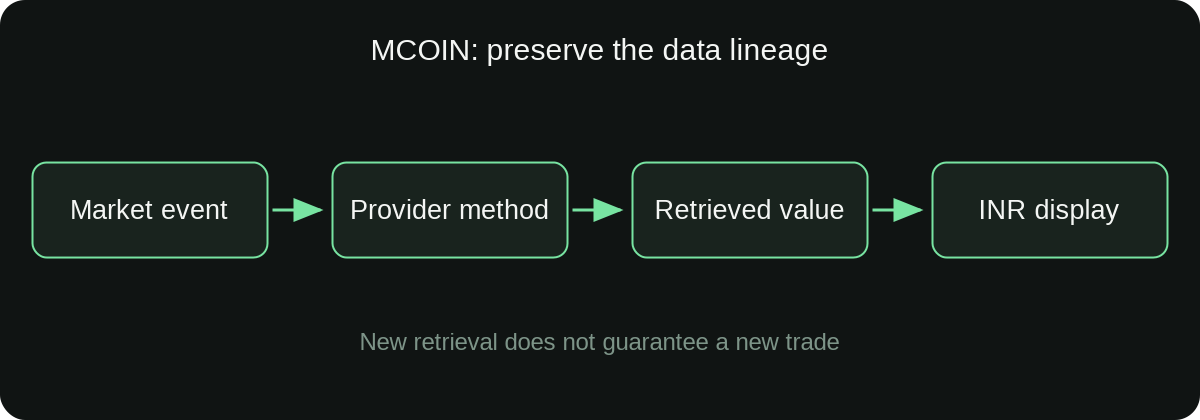
Follow the data rather than the word live
A typical price display sits at the end of a chain: market observations reach a data provider, the provider applies a method, an interface retrieves the result and a currency conversion may be added. Each step can introduce delay or mapping errors.
The CoinGecko MCOIN profile identifies a provider series. The M20 Chain website supplies project context. These sources have different roles: the project's description does not validate a provider's latest price, and the provider's profile does not verify every project claim.
The MCOIN asset article covers representation matching. This guide assumes that task is resolved and asks whether the current observation is sufficiently transparent for the intended use.
Separate three timestamps in the data pipeline
The market event time concerns the trade or observation. The provider update time concerns its processed data. The page retrieval time concerns when you received the result. These can all differ without the website clock being wrong.
A provider may document update metadata. For example, CoinGecko's simple-price API documentation describes options including a last-updated timestamp. Availability and access conditions should be checked against the current API terms.
A last-updated field is useful, but it is not automatically the timestamp of an executable bid. Understand what the provider means by the field before making a freshness claim.
| Pipeline stage | Question to record |
|---|---|
| Market observation | What event or contributing market is represented? |
| Provider calculation | Is this an aggregate, last price or another method? |
| API or page retrieval | When did this interface obtain the result? |
| INR conversion | Which currency input was applied, and when? |
The point is to preserve provenance, not to create an impressive collection of clocks that still fails to identify the actual market.
Distinguish zero, missing and stale
A zero value is a number. A missing value means no usable value was supplied in that field. A stale value may be historically valid but too old for the present task. Conflating these states can materially distort a portfolio.
A spreadsheet should preserve an explicit status alongside the price. If a request fails, keep the last successful observation with its original time rather than stamping it as new. Do not replace a failed field with zero merely to make a total calculate.
If a provider changes an asset ID or returns another series, stop the import and resolve the mapping. A successful HTTP response is not evidence that the financial input is correct.
For manual readers, the same principle applies: an attractive chart and a populated number do not settle missing market provenance. Ask what the number measures before asking whether it has risen.
Compare like observations across providers
Use the same asset representation, quote currency and time basis. Different results can arise from different market coverage, filtering or conversion methods, not necessarily from a fraudulent page.
Compare the actual contributing markets where disclosed. A composite price may intentionally exclude outliers; another source may show a single venue's last trade. Averaging the two without understanding their methods produces an unexplained third number.
For percentage returns, align the starting and ending observations. A rolling 24-hour calculation is different from a calendar-day close. A change in provider methodology can also interrupt comparability.
Keep a short discrepancy log with the competing observations and unresolved cause. This helps an editor update a page without pretending that every disagreement has been solved.
Apply the observation to the correct task
For a dated portfolio reference, a documented provider observation may be sufficient if its limitations are disclosed. For an immediate transaction, investigate the accessible market and order conditions directly.
A buyer needs acquisition prices and costs; a seller needs buying interest for the intended quantity. Neither can assume the provider's reference is reserved for them. Network support and settlement access remain prerequisites.
The separate MCOIN India budget works through destination-quantity costs. It should use verified current inputs, not whatever number happens to load first during a webpage visit.
No exact live quotation is certified here. The research did not test a synchronised market execution or Indian bank settlement, and intermittent project-site access cannot establish either outcome.
Design a responsible daily update
State the review date and timezone, then identify the observation date separately. Explain whether the page is an educational guide, a manually reviewed snapshot or an automated feed. Do not imply automation that does not exist.
If data become unavailable, show a clear status and retain the previous figure only as historical. Avoid an auto-generated price forecast that continues using an unverified cached input.
For a website operator, respect the source's licensing and access terms. Reliability includes lawful and maintainable data use, not only a working number on one occasion. Monitor failures and mapping changes before presenting the feed as dependable.
For Indian readers, keep executed transactions and reporting records distinct from the website's estimated marks. A provider's calculation method does not determine personal tax treatment or certify an exchange's authorisation.
Retain enough decimal precision to reproduce the calculation.
Frequently asked questions
Does a successful API response mean the value is fresh?
No. The response can contain cached data or an older last-successful observation. Check the documented metadata and the status of the relevant market rather than relying on transport success alone.
Can I round the price before calculating a large holding?
Premature rounding can create a material total error. Keep sufficient precision for the calculation and round the final displayed result according to its purpose, while preserving the source value.
What if my alert triggers because the INR rate moved?
That can be a legitimate currency-driven change. Label whether the alert monitors the source pair or the converted INR value, so the notification does not imply a token-market move that did not occur.