 Coin Price India
M Coin is not a unique asset name. It can refer to a blockchain asset, a loyalty unit or another issuer's product, and each has a different meaning of value. Start with the account or transaction that produced the balance, not a chart selected by similar spelling.
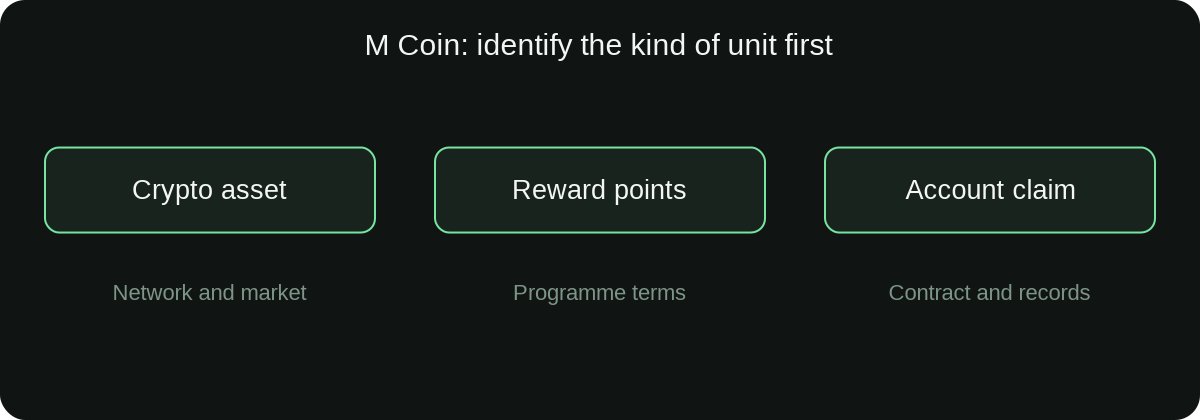
Two examples explain the naming problem
The M20 Chain website presents an ecosystem associated with MCOIN. Separately, AGTech's consumer-business description describes mCoin as MPay's points-and-benefits platform. That programme context is not a public crypto-market quotation.
The Macau Pass FAQ also discusses mCoin earning, redemption and programme conditions. Its rules concern that service and audience; they do not establish an Indian cash conversion or a relationship with the M20 Chain asset.
These examples do not exhaust every use of M Coin. They establish why spacing, capitalisation and a matching search term cannot resolve the identity on their own.
Begin from where the units came from
If you earned the balance through spending or app activity, locate the programme terms and issuer. If you bought an on-chain asset, locate the trade or transfer identifier. If someone sent only a screenshot, ask what underlying record supports it.
Record the full product name, operator, account context and unit definition. For crypto, add the network and contract or native-asset identity. For points, add the earning and redemption rules rather than inventing a blockchain address.
| Origin of units | First source to inspect | Appropriate value question |
|---|---|---|
| Loyalty programme | Issuer's current terms | Which eligible benefit can be redeemed? |
| Blockchain purchase | Trade and chain identifiers | Which matching market can buy or sell it? |
| Internal investment account | Contract and account statements | What entitlement and withdrawal right exists? |
| Promotional allocation | Campaign rules | What conditions remain before delivery? |
The table is a classification aid, not a declaration that every unit in one category is safe or valuable. Each requires its own evidence.
Reward value is usually transaction-specific
A points programme can offer discounts, vouchers or other benefits subject to conditions. The useful economic value is the benefit you can actually use, not necessarily the largest advertised redemption example.
Check eligible merchants, minimum spend, expiry, redemption caps and whether another payment is required. A voucher that reduces an intended purchase has a different practical value from one that encourages an otherwise unnecessary expense.
Transferability also needs a definition. A programme allowing gifts between users does not automatically create an open cash market. The recipient may still be subject to the same redemption restrictions.
Do not convert a points balance using the price of a same-name crypto asset. Even a perfectly current market quote would be the wrong input. The issuer's benefit rules, not a matching ticker, determine the relevant calculation.
A crypto balance needs a market-specific assessment
For an identified blockchain asset, establish the representation and supported route. A native coin, contract token and bridged unit can have different custody requirements even when branding is similar.
A price provider's INR display may be a currency conversion rather than a direct local market. Check the contributing pair, observation time and account access before calling it an Indian buying or selling rate.
The MCOIN asset guide addresses the M20 Chain-related identity task. Use it only after establishing that this is the asset meant by your M Coin record, rather than automatically applying it to every similarly named balance.
For a sale, price the relevant quantity against accessible demand and costs. For a portfolio reference, label the methodology and limitations. Those are different tasks from valuing a loyalty redemption.
Expiry messages create a separate security risk
A real points programme can be impersonated. The Macau Judiciary Police's 20 January 2025 circular warned about fraudulent mCoin-expiry messages using phishing links. That is a dated Macau warning, not an Indian ruling about all products called M Coin.
Its practical lesson is to verify a claimed expiry through the actual programme rather than the message's link. Do not supply bank or card information merely because a text promises a small reward redemption.
For crypto-themed messages, a fake expiry can instead solicit a wallet signature or recovery phrase. The label on the message does not determine what the requested action will authorise.
If you already acted, identify what was exposed: credentials, card details, a signing permission or a wallet secret. Different exposures require different responses; one password change cannot resolve all of them.
Keep separate records even if the names look identical
A personal finance sheet should give each product a unique internal label. Include the issuer or network so that automated imports cannot merge points and crypto into one line.
Keep the original statements and record how each valuation was derived. For an Indian user, actual transactions and their applicable treatment need to be assessed on their own facts. A product called coin does not automatically have the same reporting or legal character as every other coin.
The useful final answer may be a benefit value, an executable market estimate or an unresolved identity. Choosing the right category is more important than forcing every search into a live INR price.
For a household budget, count a reward benefit only once. If a voucher already reduced the purchase recorded as an expense, adding its face value again as cash income would overstate the combined benefit.
For travel-related programmes, check whether your account and location qualify before counting a redemption in an Indian household budget.
Frequently asked questions
Does the ability to gift points make them legal tender?
No. A transfer feature describes a programme function. Legal tender status, redemption obligations and payment acceptance depend on separate rules and should not be inferred from gifting alone.
Can I combine two same-name balances in a portfolio total?
Only if their economic identity and valuation basis genuinely align. Otherwise keep them separate, with a note explaining each unit and the relevant conversion or benefit method.
What if an export omits the issuer name?
Retain the raw entry and flag it for investigation. Use the original account statement or transaction context to resolve it before attaching a market feed or assigning cash value.