 Coin Price India
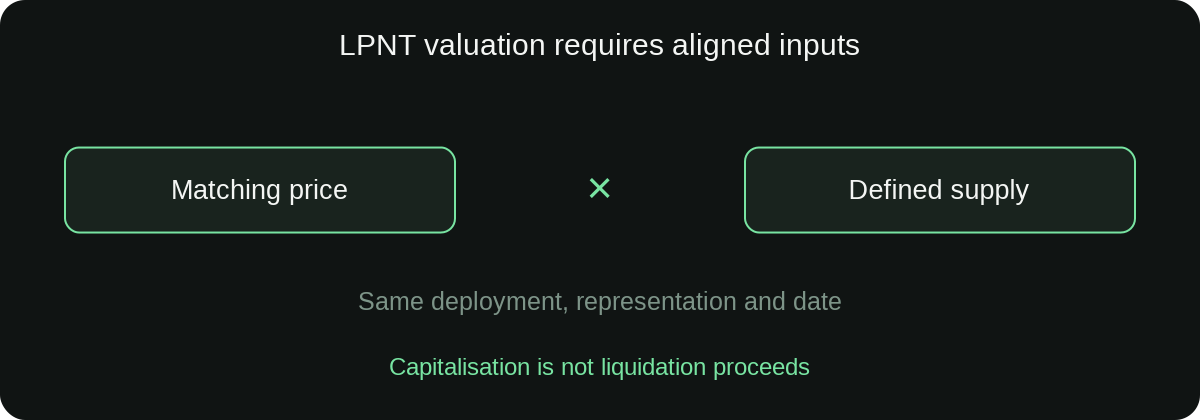
An LPNT token price must be matched to a particular deployment and a clearly defined supply figure. A ticker, an old whitepaper total and a current price widget are not enough to calculate a defensible market valuation. Confirm that the inputs describe the same asset and date.
Start with the deployment record
The LPNT name appears in project references and token-information services. A specific CertiK Ethereum token-scan page identifies a deployment by network and address. That scoped record should not be generalised to every same-name token on other networks.
The historical project whitepaper supplies background, but historical documentation is not a substitute for checking the actual deployment and current state. Preserve the document date beside any figures taken from it.
A deployment record should include network, address, decimals, source version where available and observation height or time. Those fields make the later price and supply calculation reproducible.
Decimals change presentation, not economic supply
Token balances are often stored as integers and displayed using a decimal convention. The Ethereum ERC-20 documentation describes the standard interface, including balance and total-supply functions, while decimal metadata helps interfaces present values.
If raw units are interpreted without the correct scale, a wallet or spreadsheet can show a dramatically wrong quantity. Multiplying that error by a valid price does not rescue the valuation.
Check whether a data export already applied the decimal adjustment. Applying it twice produces the opposite error. Keep raw and displayed quantities in separately labelled fields if both are needed.
Do not assume a token's decimal setting from the familiar appearance of its ticker. Verify the actual deployment metadata. This is a data-integrity task, not evidence that the token itself is economically attractive.
Define which supply you are using
Total supply, maximum supply and circulating supply answer different questions. A contract's supply reading may describe minted units, while a provider's circulating figure applies a methodology concerning which units are available to the market.
Locked allocations, treasury holdings, exchange wallets and bridged representations can complicate the calculation. A token residing in a large address is not automatically circulating or permanently unavailable. Its control and restrictions matter.
| Measure | Question it answers | Limitation to preserve |
|---|---|---|
| Contract total supply | How many units the deployment reports | May not define market circulation |
| Maximum supply | What ceiling the relevant rules specify | Requires verified rules and scope |
| Circulating supply | What a provider counts as market-available | Depends on methodology and date |
| Represented supply | What another chain or wrapper records | Can duplicate underlying exposure |
A responsible valuation names its denominator rather than presenting one unexplained supply number as universal truth.
Check permissions without turning a scan into a guarantee
Contract analysis can examine functions and privileged roles, such as minting, pausing, upgrades or transfer restrictions where applicable. A scanner's conclusion applies to the code and state it analysed, using its own detection method.
Do not infer that every listed risk exists in LPNT. Equally, a result saying a function was not detected is not a complete guarantee about all off-chain arrangements or future market conditions.
An audit should identify its scope and code version. It does not certify a market price, issuer solvency, Indian permission or the safety of an unrelated bridge. These questions need their own evidence.
For any claim about a changed contract, locate the authenticated migration or upgrade record. A new address posted in a chat is not sufficient. Preserve both the old identifier and the evidence linking it to the replacement.
Avoid double counting across networks
A bridge can lock or otherwise account for an underlying asset while issuing a representation elsewhere. Adding both quantities as independent economic supply may overstate the number of claims being valued.
The correct treatment depends on the actual mechanism. Identify who controls the bridge, how issuance relates to backing and whether redemption is available under defined conditions. No bridge arrangement is assumed here merely because two tokens share LPNT branding.
A provider may consolidate representations into one series or maintain separate records. Understand that choice before combining price and supply fields from different websites.
If the mapping cannot be established, keep separate records and disclose the limitation. An incomplete but transparent dataset is preferable to a precise capitalisation built from incompatible inputs.
Calculate valuation only after the inputs align
A simple market-capitalisation calculation multiplies a matching price by the chosen circulating quantity. Fully diluted valuation uses a different supply basis. Neither number measures how much cash holders could collectively withdraw.
For an INR presentation, convert the resulting value using a documented currency rate and time. Avoid comparing one provider's INR total with another provider's dollar total unless the asset, supply basis and timestamps also align.
The LPNT execution article addresses the distinct question of selling a quantity into bids. A capitalisation calculation cannot replace that market-depth assessment.
Retain a calculation sheet with source, denominator definition, contract identity and unresolved assumptions. Indian reporting or investment decisions should follow verified transaction facts and relevant advice rather than a low-price or low-cap label alone.
When comparing supply observations, record the blockchain height where possible. Two readings from different heights need not match if the underlying rules permit supply changes. That difference requires explanation before an editor calls one provider inaccurate; neither reading should be silently transplanted into another date’s valuation.
Frequently asked questions
Does sending tokens to an inaccessible address always reduce total supply?
Not necessarily. Economic inaccessibility and a contract-level burn can be recorded differently. Check the transaction mechanism and provider methodology before describing a transfer as a verified supply reduction.
Can an explorer label establish who ultimately controls a large holder address?
A label can help investigation, but it may be incomplete or outdated. Ownership and beneficial control require corroboration. Do not turn an unverified address label into a personal allegation.
What if two providers publish different circulating supplies?
Record both definitions and dates before choosing one. If their methods cannot be reconciled, present separate valuation scenarios or omit the combined metric rather than averaging unexplained quantities.