 Coin Price India
A page dated today does not necessarily contain a trade from today. For LPNT, check the underlying observation time, market state and asset mapping before relying on a price or percentage change. If those checks fail, label the quotation historical or unavailable.
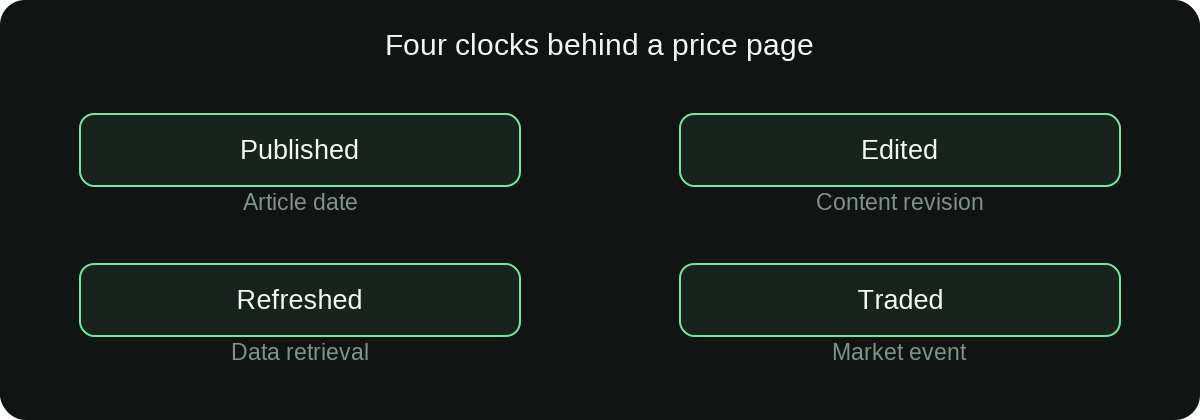
Separate four clocks on a price page
A website can have a page-publication date, a content-update time, a data-refresh time and the timestamp of the last actual trade. Those clocks measure different things. A refreshed page may still be displaying an old market observation.
Some information aggregators show separate system and price update fields. The LPNT detail page on aWebAnalysis is a useful example to inspect for that distinction. Do not treat a system refresh as evidence of a new transaction.
For a real decision, identify which clock is attached to the number. If the site does not explain it, retain the uncertainty rather than assigning the most recent visible date to every field.
Start with the market event, not the chart animation
A moving widget can update conversion rates or redraw an unchanged value. That does not mean LPNT traded again. Find the actual market and look for recent trades, the pair and the observed sizes.
A flat chart can likewise mean several things: unchanged trading, sparse activity, missing coverage or carried-forward data. Do not call it price stability until the trade and coverage evidence supports that interpretation.
Use the LPNT identity guide first if the asset version is unclear. A perfectly fresh quotation for the wrong deployment is not a useful current price for your holding.
Compare providers without averaging incompatible inputs
A CertiK LPNT profile can display market information alongside its security-related content. The provider's published fields are one observation source, not an executable order or a complete assessment of every venue.
For each quotation, record full asset, chain, pair, venue coverage, quote type and time. A provider may use one market while another aggregates several. A converted INR number can also move independently of the underlying token quotation.
If two inputs disagree, investigate the cause before choosing either. Their average is not automatically a better price, especially when one is stale or mapped to a different asset. Preserve both records with their methods.
A practical freshness classification
| Classification | Required interpretation |
|---|---|
| Recent identified trade | Valid observation of that event, not guaranteed execution |
| Current bid or ask | Offer under its visible size and conditions |
| Delayed data | Useful only with the delay understood |
| Last known value | Historical reference, not a new quote |
| Missing or unresolved input | Do not silently substitute zero or an old value |
The categories are a reading method, not an invented rating of LPNT's present market. Apply them to the specific source you inspect. There is no universal number of minutes that makes every feed appropriate for every task.
A learning exercise can tolerate a clearly labelled historical observation. A time-sensitive order needs relevant execution evidence. A financial record may require a particular valuation time and method rather than the freshest available number.
Check whether the percentage change uses the same base
A 24-hour rolling comparison differs from a calendar-day close. An INR change combines token movement and the currency input. A provider changing market coverage can also alter a series without reflecting a comparable trade in your account.
Retain the starting value, ending value and timestamps before checking the percentage formula. The arithmetic is ending divided by starting, minus one, multiplied by 100. If the starting value is missing or rounded to zero, that calculation needs special handling rather than a dramatic headline.
For example, a very small starting number can create a large percentage from a modest absolute difference. That is a property of the denominator, not evidence that a large amount of capital entered the market. Check trade size separately.
Review the source's availability state
A page continuing to display a converter table does not establish active deposits, trading or withdrawals. Inspect the venue's current service information. A market can also remain listed while a particular network is under maintenance.
Do not describe a missing feed as proof that the entire blockchain stopped or that all holdings are worthless. Those are different claims requiring their own evidence. Restrict the conclusion to the data or service actually inspected.
If a comparison depends on a particular source and that source fails, document the failure and the last valid observation. Switching silently to another provider can change the method and make the before-and-after comparison unreliable.
Set an update rule for your own tracking
A useful record contains the source, underlying timestamp, retrieval time, method and a stale-data flag. Define the flag for your task and keep it visible. An old number should not retain a green live label merely because a script still loads it successfully.
For a website, ensure the displayed date is tied to actual data retrieval rather than a generic current-date function. If the feed is unavailable, explain that state and retain a separately labelled last observation only where useful.
Use fresh data without overstating what it proves
Even a recent trade does not establish deep liquidity or the amount obtainable for your position. Once freshness is settled, assess execution and costs separately. A reliable timestamp solves the age question, not every investment question.
Keep the distinction in your notes: data age, asset correctness and route usability are independent checks. A source can pass one and fail another. That is more informative than calling the entire page either accurate or useless.
Frequently asked questions
Does refreshing my browser create a newer token price?
No. It only requests another page or response. Check whether the underlying market observation changed instead of assuming a new retrieval means a new trade.
Can a weekend timestamp use a different timezone from my phone?
Yes. Compare the stated source timezone and your local display before treating the calendar date as a discrepancy. Preserve the original time alongside any conversion.
Should I remove stale observations from my historical file?
Retain the raw data and mark their status. If you exclude them from an analysis, document the rule in a separate working series rather than destroying the evidence of what the source supplied.