 Coin Price India
LPN is not enough information to identify a crypto asset. It may be an informal reference to LPNToken, whose ticker is LPNT, or a different token altogether. Establish the full name and technical identifier before using an LPN price in an Indian portfolio.
A short label can hide an important mismatch
Search engines often expand abbreviations using popular associations. Spreadsheet exports, social posts and wallet labels can also shorten names. A result for LPNT may therefore appear relevant to an LPN query without proving that it describes the user's holding.
The LPNTOKEN project profile uses the LPNToken branding, and the project's historical whitepaper supplies project context. Those sources help explain a possible naming relationship; they do not establish that every asset labelled LPN is LPNT.
Do not correct the user's label by assumption. The right question is what the original record meant. A spelling variation and a genuinely different token require different treatment.
Build an alias crosswalk
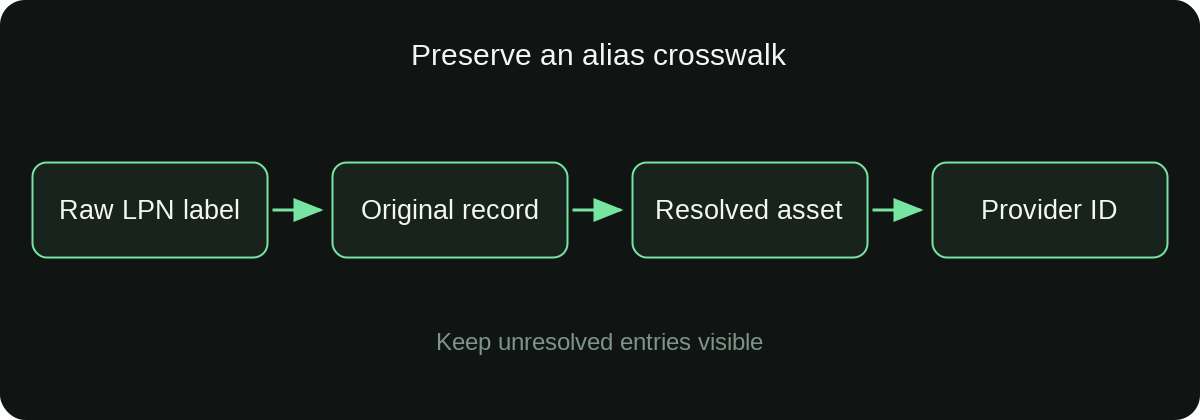
An alias crosswalk connects human-readable labels to a stable asset identity. It is particularly useful when old records use LPN, newer records use LPNT and a data service uses a longer project name.
Give each raw label its own row. Record where it appeared, the date, the proposed match and the evidence supporting that match. Retain an unresolved state rather than forcing every row into the nearest familiar project.
| Raw record | Proposed interpretation | Evidence needed before acceptance |
|---|---|---|
| LPN in a personal note | Possibly an abbreviation | Original purchase or transfer record |
| LPNT in a token export | A ticker-level match | Network and contract confirmation |
| Long project name in a price feed | A provider's asset series | Provider ID and contributing markets |
| Same label on another chain | Possibly another representation | Documented bridge or issuer relationship |
The crosswalk's purpose is not to create more labels. It makes each change accountable, so a price import cannot silently attach unrelated market data to an old balance.
Recover meaning from the original transaction
Start with the acquisition source. A receipt, exchange export or blockchain transaction can provide identifiers absent from a handwritten portfolio entry. Keep the unedited original alongside your working interpretation.
For a token transfer, inspect the network and contract using an appropriate explorer. A native-coin transfer has different evidence. The transaction's recipient and displayed token name should not be mistaken for a complete contract authentication process.
For an internal platform balance, request the terms defining the units and any withdrawal conditions. It may not correspond one-for-one with an on-chain token. If the platform cannot establish that relationship, a public LPNT quotation cannot repair the missing evidence.
An old email can be useful, but verify the sender and preserve headers where practical. A later unsolicited message claiming to clarify your balance may instead be an attempt to obtain credentials or another payment.
Repair a spreadsheet without rewriting history
Create separate fields for raw label, resolved asset, resolution date and evidence link. Keep the raw quantity unchanged until you know whether any migration, redenomination or other event affected units.
Next map the resolved asset to a provider's unique ID. Avoid formulas that fetch whichever search result matches three letters. A valid-looking currency number can be more dangerous than an error because it hides the mismatched input.
Use a three-state output: identified with usable data, identified with unavailable data, or unresolved identity. This distinguishes a market-data problem from an asset-identification problem. Neither should automatically become zero.
Test the mapping on a small number of historical rows before applying it across the portfolio. Compare the returned name, chain and observation date with the underlying records. Keep a change log so an adviser can understand corrections later.
Only then choose a price measure
An identified asset can still have several prices: a last trade, market average, bid, offer or internal programme rate. Choose the measure that serves the task and label it explicitly.
For a reference INR value, record the quote currency, price timestamp and conversion-rate timestamp. For a sale estimate, investigate accessible bids, quantity, costs and settlement. A conversion formula alone does not establish an available exit.
The separate LPNT price guide covers the underlying market-identification task. This article addresses the earlier data-cleaning problem: whether the abbreviated record is entitled to use that guide's asset at all.
If a resolved holding has no reliable current quotation, preserve the identity result. It is still progress. Do not substitute an unrelated liquid token merely to complete a portfolio total.
Explain corrections clearly to other people
When sharing an updated statement, distinguish a naming correction from an economic event. Reclassifying LPN as LPNT does not itself mean you bought, sold or received anything. A real conversion or transfer requires separate evidence.
For Indian accounting or tax records, provide the source transactions and reconciliation rather than only the corrected market-value total. A professional needs to understand how the holding arose and what actually changed.
Never supply a seed phrase to a person offering to resolve a ticker. Asset research should normally rely on public identifiers and transaction evidence, not control over the wallet. Redact unrelated personal data before requesting external help.
A careful alias process may take longer than selecting the first search result. Its benefit is that future price updates, audits and transaction decisions start from the same identified asset rather than repeating the ambiguity.
Frequently asked questions
Can I standardise all old labels before I finish investigating them?
You can standardise formatting while retaining unresolved identity. Use a review flag rather than converting an uncertain label into a confirmed asset. That keeps the dataset tidy without creating unsupported financial information.
What if the original platform has disappeared?
Preserve remaining statements, emails and transaction references. Public chain records may resolve some questions, but missing terms or ownership evidence may remain unresolved. Do not invent certainty merely because the original source is unavailable.
Should a corrected portfolio show both the old and new asset names?
For a transition period, showing the original label alongside the resolved identity can help readers follow the reconciliation. Explain whether the change is editorial or reflects an actual asset event.