 Coin Price India
A BDX rate should identify the asset representation, market and observation time. Native Beldex and a token represented on another network require different transfer checks, even when both use BDX. A current-looking INR widget cannot establish that your balance can be deposited and sold.
What changed in the project's 2026 communications?
Beldex's official announcement index records 2026 updates concerning native-network reconciliation, BDX-BSC migration and wallet integrations. These are dated project communications, not reasons to assume every historical route remains valid.
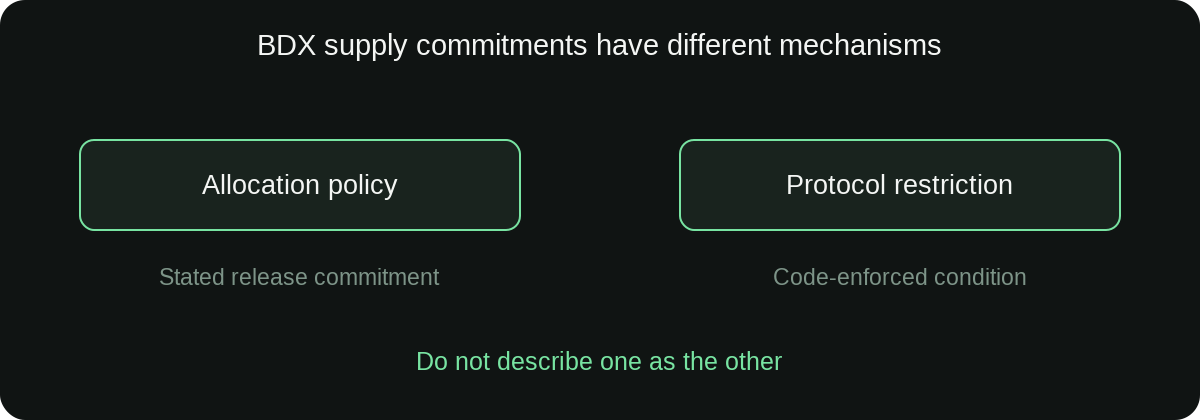
Its 16 October 2026 allocation announcement describes a suspension of specified scheduled releases from 30 September 2026 to 30 September 2028. Importantly, it characterises the arrangement as allocation management rather than a protocol-enforced cryptographic lock.
That distinction limits the conclusion. A release-policy commitment is not the same mechanism as code preventing spending. It also does not by itself establish a future price, a change to maximum supply or a guaranteed reduction in selling pressure.
Identify which BDX the quotation values
Begin with the balance you hold. Record whether it is native BDX or another representation, its network and the receiving provider's exact support. Do not choose a network solely because its transfer fee looks lower.
A representation can introduce bridge or custodian dependencies that differ from native-chain use. The market's ticker may not expose those dependencies prominently. Verify the contract or native-asset mapping through authenticated current materials.
| Record | Why it matters |
|---|---|
| Asset representation | Determines the transfer and custody mechanism |
| Supported network | Prevents assuming same-ticker compatibility |
| Market and quote currency | Identifies what the rate actually measures |
| Observation time | Distinguishes a current trade from cached data |
| Account eligibility | Determines whether the route is usable by you |
The result is a rate attached to a specific route, not an abstract BDX number applied to every balance bearing the name.
Read a price move without confusing it with an announcement
A release or wallet announcement can be relevant context, but timing alone does not prove it caused a particular market move. Broader crypto conditions, liquidity and venue-specific activity can also affect the observation.
Record the market data before adding an explanation. Identify whether the percentage compares rolling 24-hour values, daily closes or another interval. A green number after a project update is not evidence of a reliable trading rule.
Similarly, a supply-policy announcement may concern only designated allocations. It should not be rewritten as all BDX being locked, all emissions stopping or every holder becoming unable to transfer.
Where the mechanism depends on a stated commitment, describe it that way. Independent verification of a wallet balance and enforcement of a future spending restriction are different questions.
Convert a valid rate into an INR reference
For a BDX/USDT observation, multiply the rate by an appropriate INR-per-USDT input. Keep the quote and currency timestamps visible. Do not silently treat USDT as one redeemable US dollar for every Indian transaction.
For a quantity-based reference, multiply by the relevant holdings category. If part of a balance is unavailable or represented elsewhere, explain that limitation before calculating a total.
A reference conversion is useful for orientation, but an acquisition budget uses offers and costs; a disposal estimate uses bids and accessible depth. These tasks can produce different numbers at the same instant.
This article supplies no exact live rate because a synchronised, executable Indian route was not tested. A documented method is preferable to calling an unsynchronised provider snapshot today's guaranteed price.
Privacy features do not remove transaction obligations
Beldex positions itself around privacy-focused infrastructure. That positioning should not be treated as a guarantee of complete anonymity across every wallet, bridge or exchange interaction.
An exchange can collect account information independently of a chain's privacy design. A bridged representation can also expose different information from the native network. Evaluate the particular route rather than transferring one privacy claim across all products.
For Indian users, preserve records required to explain acquisitions, transfers and disposals. Privacy technology does not establish an exemption from applicable reporting or tax obligations. Obtain advice on the actual transaction rather than relying on a token category.
No platform is recommended here as authorised for all Indian residents. Service conditions, account restrictions and current transfer support need publication-time and transaction-time checks.
A practical rate-check routine
Save the source, asset identifier, market, price method and observation time. Inspect the provider's contributing markets where available. Check whether an apparent update reflects new trading or only a refreshed page.
Before moving funds, confirm the destination's current network support and any maintenance notice. A historical integration announcement is not a live deposit-status test. Retain the address and network instructions supplied for your account.
After a transaction, compare the amount sent, fees, amount credited and any subsequent trade. Keep operational records separate from the portfolio mark so a discrepancy can be traced to its actual stage.
The useful outcome is a verifiable rate and route for the task at hand. It is not a prediction that an ecosystem announcement must produce a higher price.
For a representation change, keep the old and replacement identifiers in separate rows. Record the authenticated notice linking them, any conversion condition and the resulting transaction. A renamed wallet entry alone does not establish that the migration occurred or that an exchange accepts the replacement.
Frequently asked questions
Does a view key allow someone to spend BDX?
The project's allocation announcement distinguishes viewing from spending authority. A view key can expose information without granting the same powers as a spend key. Treat any key disclosure according to its actual scope rather than sharing secrets indiscriminately.
Can an archived explorer disagree with the current network view?
Yes, an archive can intentionally represent an earlier state. Check the explorer's stated purpose and height before using it to reconcile a current balance or claiming that a discrepancy proves a loss.
Does a wallet integration guarantee an exchange listing?
No. Wallet support concerns storage or interaction functions. An exchange listing, market depth and settlement access require separate evidence from the relevant provider.