 Coin Price India
A QR code containing a private key or recovery secret can expose spending authority over the relevant funds. It is not the same as a receive-address QR. Do not upload, publish or send it to someone merely because they describe scanning as verification.
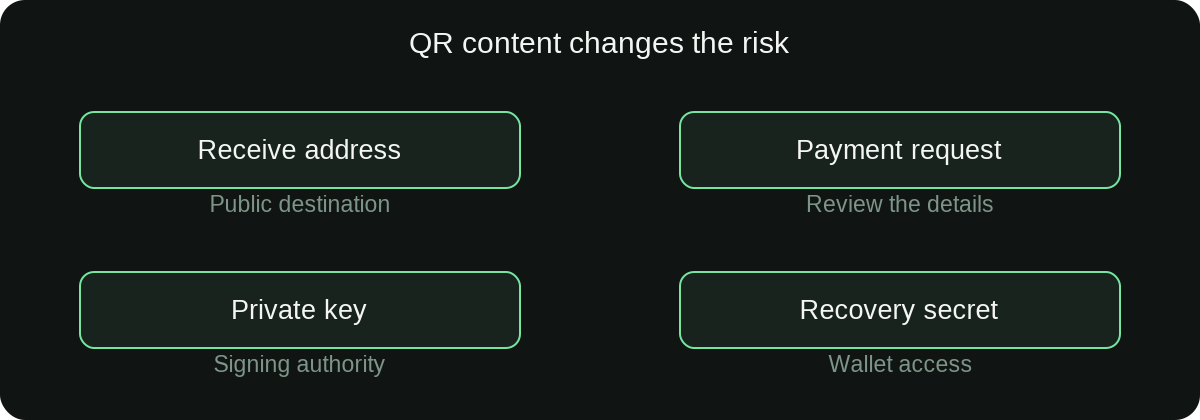
The square pattern does not tell you what it contains
A QR code is a way to encode data. It can carry an address, payment request, website link, secret or other text. Its appearance does not establish whether it is safe to share. The important question is the underlying content and how an application will use it.
A receiving QR generally helps another person direct a payment to you. A private-key QR can help a compatible wallet obtain signing authority. A recovery-phrase QR may affect more than one address, depending on the wallet arrangement. Those roles should not be confused.
Do not use visual similarity as the test. Two codes displayed by the same app can serve very different purposes. Read the surrounding label and the wallet's documentation before copying, printing or sharing either one.
Payment requests can contain more than an address
Bitcoin's BIP 21 payment-URI specification documents a payment-request format with fields beyond the destination, such as amount and labels. It is a reference for understanding how payment QR content can work, not a requirement to use that historical format in every wallet.
After scanning a payment request, inspect the destination and amount in your own wallet before confirming. A readable label can be misleading, and a QR can direct you to a website rather than create a payment request at all.
The absence of a visible private key does not make every QR safe. A malicious destination can still cause an unwanted payment or take you to a phishing page. Sharing a secret and approving a deceptive payment are different risks.
Know which access material you possess
Bitcoin.org's wallet and security explanations provide a primary starting point for understanding keys and control. In practical use, identify the wallet type and recovery method instead of assuming every code controls exactly one coin or account.
| Encoded content | Practical consequence |
|---|---|
| Public receive address | Can identify a destination and reveal associated public activity |
| Payment request | Can prefill transaction details that still need review |
| Private key | Can expose the signing authority linked to that key |
| Seed or recovery material | Can affect a broader wallet under its design |
| Website URL | Can lead to a page requiring a separate trust assessment |
A multisignature or other controlled arrangement can have additional requirements, so avoid a universal claim that every single key independently moves all funds. Nevertheless, treat secret material as confidential rather than relying on assumed restrictions to make disclosure harmless.
Do not use an online decoder for an unknown secret
Uploading a potentially sensitive QR to a website can give its operator the encoded content. The fact that the tool promises to decode locally is a claim that needs evidence; it should not be tested using valuable signing material.
Begin with the source and documentation. If legitimate recovery requires decoding, use a trustworthy process and environment appropriate to the wallet. Avoid sending the image to a general support account, public forum or image-search service to ask what it means.
Copies can persist in photo backups, shared albums, messages and documents. Deleting one visible image does not demonstrate that every copy has disappeared. Plan secret handling before generating or photographing recovery material, not after it has been distributed.
A printed backup needs a complete recovery plan
Printing a QR can reduce one device-access dependency while creating physical-storage risks. Check that the backup is legible, durable and understood. Also preserve any additional information required for recovery, such as the correct wallet context or separate passphrase where applicable.
Do not scan a secret into an unfamiliar app merely to test the print. A test that exposes the key can defeat the protection you intended. Follow the wallet provider's documented verification or recovery procedure in a controlled setting.
A paper labelled cold storage is not automatically secure. If the secret was generated or copied in an exposed environment, the paper does not erase that history. Storage format and secret-generation integrity are separate questions.
If a private-key QR has already been exposed
Treat the relevant credentials as potentially compromised. Determine which wallet or assets they affect and whether you retain valid access. Use a clean environment and verified wallet software to assess a secure move where appropriate.
Changing an app PIN or a website password does not necessarily change an exposed blockchain key. Restoring the same disclosed recovery material on a new device does not make the secret unknown again. A new device and a genuinely new credential arrangement are different things.
If funds are already moving unexpectedly, avoid blindly adding fees to the affected account. Preserve transaction evidence and obtain trustworthy technical help through verified channels. No general support agent can guarantee reversal of a confirmed blockchain payment.
Protect public information too
A receive address is designed to be shared for payment, but publishing it can connect your identity with public transaction history on applicable networks. That is a privacy consideration rather than a reason to reveal a private key instead.
Share only the information needed for the task. For a missing-payment enquiry, a transaction ID, network and relevant public destination can be useful. A full wallet backup is not necessary to inspect public evidence.
If preparing educational illustrations, use clearly labelled dummy content rather than real credentials. This article's figure explains categories without embedding a usable private key or a scannable secret.
Read a QR request as an authorisation decision
Ask what will happen after scanning and after any confirmation. Viewing a request, importing a key and signing a transaction are separate actions. A familiar app cannot protect you from every mistaken authorisation if you ignore what it is asking to do.
Pause when the action differs from the task. Receiving money should not require exposing your recovery secret. Checking a public balance should not require granting a stranger signing access. That simple relationship is a useful first check before any more technical investigation.
Frequently asked questions
Can I safely blur only the centre of a private-key QR before posting it?
Do not rely on partial masking. QR error correction and other copies can make that approach unsafe. Exclude secret images entirely from public material rather than guessing how much obstruction is enough.
Does a screenshot become safe if the wallet balance is currently zero?
Not necessarily. The credentials may control other assets or future deposits. A zero visible balance is not a reason to publish signing material.
Is a wallet-import QR necessarily a request to send funds?
No. Importing credentials changes access rather than directly creating a payment, but it can still expose control. Identify the operation before continuing instead of treating every scan as harmless viewing.